
1 in 3 of Our Auto-Generated YouTube Videos Get Cited by AI: Data From 104 Videos
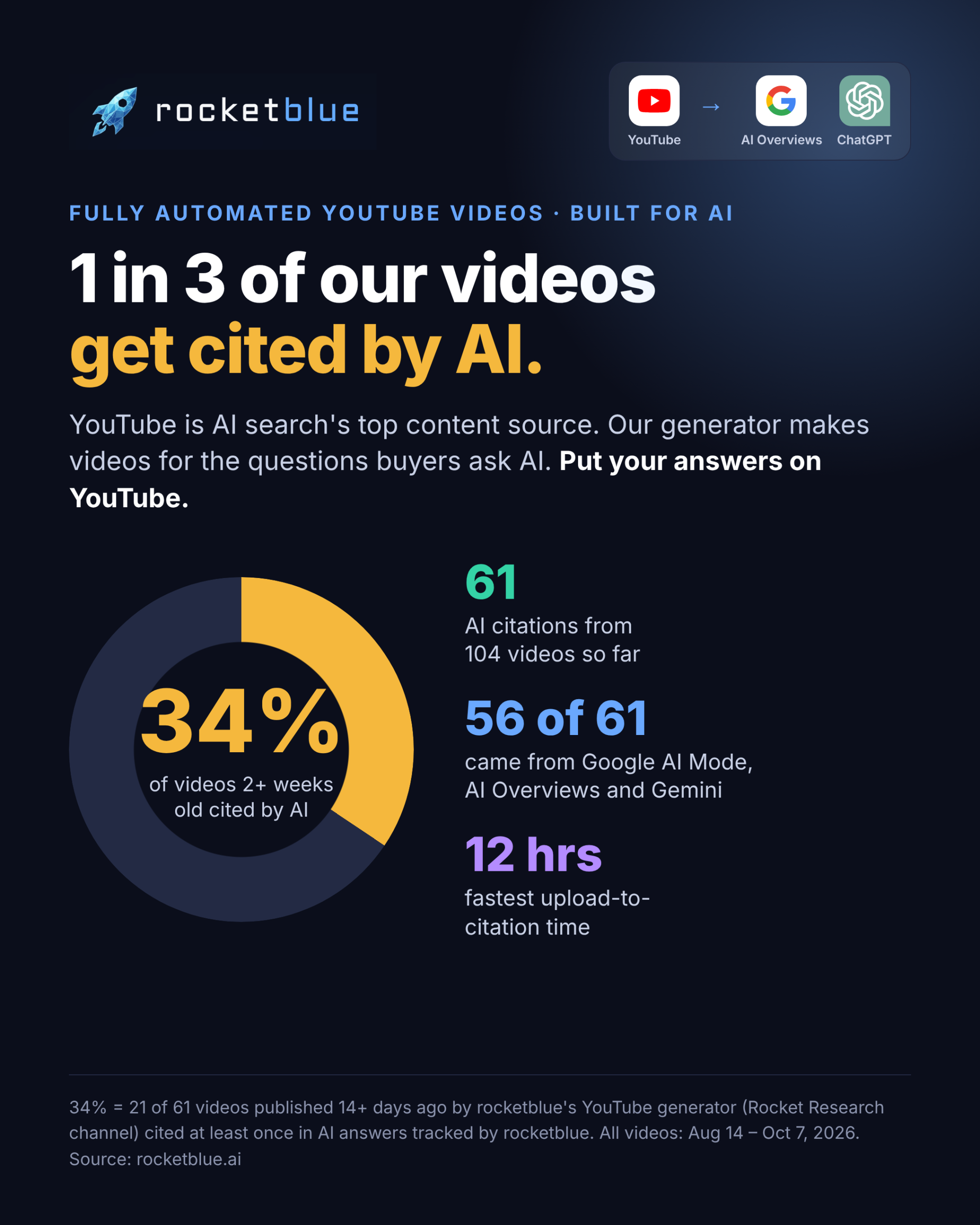
YouTube is one of the sources AI answers cite most, so in mid-August we started publishing AI-ready videos with a fully automated generator. We tracked all 104 videos it published to our Rocket Research channel between August 14 and October 7, 2026. One in three videos that has been live for two weeks or more (34%) is already cited in AI answers. Across all 104 videos, including ones published just days ago, 25 have been cited a total of 61 times.
TL;DR: What to Do About YouTube and AI Search
- Want to show up in Google’s AI answers? Publish on YouTube. 56 of our 61 citations came from Google AI Mode, Gemini and AI Overviews.
- Want results fast? Make one video per real prompt and optimize for the searches the AI runs behind the scenes. Our fastest video was cited about 12 hours after upload.
- Want it to keep working? Give videos two weeks. 34% of videos older than two weeks are cited, compared with 9% of newer ones.
- Want ChatGPT too? Don’t rely on YouTube alone. ChatGPT hasn’t cited any of our videos yet, so keep publishing on your site and on the third-party pages it reads.
YouTube Is the Most Cited Content Source in AI Search
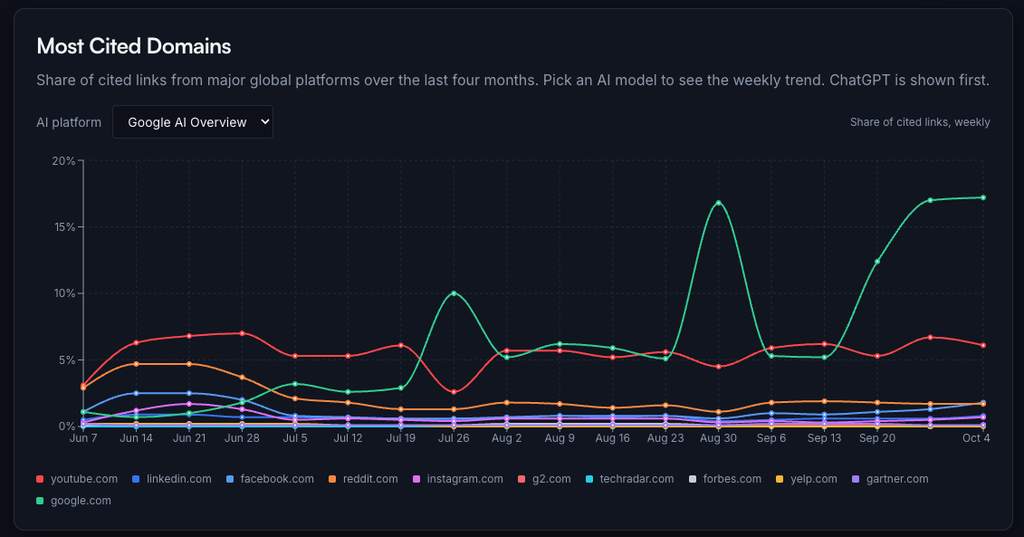
In rocketblue’s own tracking for the four weeks from September 7 to October 4, 2026, youtube.com was the second most cited domain across all AI engines, with 30,739 citations. Only google.com ranked higher, and that domain is mostly Google’s own Maps and search links, not content. That makes YouTube the top content source AI answers point to. In the most recent full week, it ranked #2 in both Google AI Mode (8.3% of all citations) and Google AI Overviews (6.1%).
Outside data shows the same thing. Ahrefs’ March 2026 study of 4 million AI Overview URLs called YouTube “the most cited domain in AI Overviews,” at 5.6% of all cited URLs, up 34% in six months. Among cited pages that don’t rank in Google’s top 100, 18.2% were YouTube URLs. In other words, a video can get cited even when it would never rank on page one. You can follow our weekly numbers on the rocketblue AI Visibility Stats page.
Here’s the catch: most brands don’t have a video for the exact questions their buyers ask AI. Filming, editing and publishing a video for every prompt you care about is too slow. So we automated it.
We Built the Generator From 1,000 Highly Cited Videos
Before we generated a single video, we analyzed 1,000 YouTube videos that AI engines cite often. We built a profile of what they have in common. Format mattered most: 85% of the most cited videos used a comparison, ranked list or testing format. Cited transcripts also named far more products and tools (about 5.4 per transcript versus 0.8 for less cited videos), and most closely matched the wording of real user prompts. Production quality, video length and channel size barely mattered. That profile is now the template behind every video the generator makes.
The Videos Are Made for AI, Not for Humans
Large language models don’t watch videos. They read the title, the description and the transcript. So our videos are built for those readers. Each one uses a single static image with a voiceover. There’s no filming, no b-roll and no editing, because none of that changes what the AI reads. All the effort goes into the words.
To be clear, these videos are not designed to win human viewers or subscribers. They are designed to be the best possible source for an AI answer.
The Process Is Fully Automated
- Pick the prompt. rocketblue finds a tracked prompt where your brand is missing or weak in AI answers.
- Extract the fan-out queries. When an AI model answers a question, it quietly runs its own traditional search queries in the background. These are called fan-out queries. rocketblue captures the queries the models actually used for that prompt, so the video is optimized for what the AI searches for, not just for the prompt itself.
- Write to the profile. It writes a title that matches the prompt’s wording, a description that answers it directly and names the options covered, and a spoken script of about 450 words that opens with the answer and covers the fan-out queries.
- Produce the video. It generates the voiceover and a static image and renders the video.
- Publish and track. It uploads the video to the Rocket Research YouTube channel, up to one a day per brand, and then checks every tracking run to see whether AI engines cite it.
No one films, edits or uploads anything. Of the 104 videos in this study, 36 were created and published by the daily automatic schedule, all since September 28. The rest were started with one click from a suggestion in the app. The video generator is included in every rocketblue plan.
One in Three Videos Older Than Two Weeks Is Cited by AI
Of the 61 videos that have been live for at least 14 days, 21 have been cited in an AI answer that rocketblue tracks. That’s 34%. Across all 104 videos, 25 have been cited, earning 61 citations in total. The best performer, “Best AI Visibility Tools That Don’t Require a Marketing Team to Manage,” was cited 9 times by four engines: Google AI Mode, AI Overviews, Gemini and Claude.
| Group | Videos | Cited | Share cited |
|---|---|---|---|
| Published 14+ days ago | 61 | 21 | 34% |
| Published in the last 14 days | 43 | 4 | 9% |
| All videos | 104 | 25 | 24% |
The age split matters. Most of the newest videos have only been through one or two tracking runs, so the all-videos number undercounts where things are heading. Videos that have had two weeks to be picked up are cited at a 34% rate.
Citations Can Arrive Within Hours
The fastest video was cited about 12 hours after upload. Seven of the 25 cited videos were picked up within three days, and 12 within a week. The median time to first citation was about 8 days. Because we only see a citation when a tracking run happens, these are upper limits. The real time may be shorter.
Compare that with a new blog post on your own domain, which often needs weeks to get crawled, indexed and trusted. YouTube is already crawled and trusted, so a new video can show up in AI answers right away.
Google’s AI Engines Cite the Videos Most
| AI engine | Videos cited | Citations |
|---|---|---|
| Google AI Mode | 16 | 21 |
| Gemini | 15 | 23 |
| Google AI Overviews | 11 | 12 |
| Perplexity | 2 | 2 |
| Claude | 1 | 3 |
| ChatGPT | 0 | 0 |
Google owns YouTube, and Google’s three AI products (AI Mode, Gemini and AI Overviews) produced 56 of the 61 citations. That makes sense: these engines lean on YouTube more than on any other content site. Perplexity and Claude cited a few videos, and ChatGPT hasn’t cited any yet. The Perplexity, Claude and ChatGPT counts are small, so don’t read too much into them, but the lesson is clear: YouTube is mainly a Google play, and it works best next to on-site content, not instead of it.
Why AI-Optimized Videos Get Cited
- AI reads the words, not the pictures. Engines work from a video’s title, description and transcript. That’s why a static image is enough, and why the script is where the work goes.
- The video matches what the AI searches for. By optimizing for the fan-out queries the models run, the video shows up in the exact searches the AI uses to build its answer.
- Long-tail prompts have little video competition. A question like “Can a small business owner set up AI brand monitoring without technical help?” has few or no videos made for it. A focused video can be the best match right away.
- The format copies what already works. Every video follows the profile we built from 1,000 highly cited videos, so it starts out shaped like content AI engines already trust.
- Volume compounds. At one video a day, a brand can cover dozens of prompts in a month. A one-in-three hit rate adds up to a lot of new citations.
Where YouTube Fits in Your AI Visibility Plan
| If you care about | Focus on | Then add | Don’t rely on |
|---|---|---|---|
| Google AI Mode and AI Overviews | YouTube videos for each key prompt | Matching blog posts on your site | Ranking on page one alone |
| Gemini | YouTube videos with full, accurate transcripts | Mentions on third-party “best of” pages | Your homepage copy |
| ChatGPT | Your site and widely cited third-party pages | Reddit and review sites | YouTube alone |
| Fast wins on niche prompts | One video per long-tail prompt | Daily publishing | A few broad, generic videos |
Checklist: Make Videos AI Engines Will Cite
Items 1, 2, 7 and 8 come straight from what our data shows. The rest are practices built into our generator from the 1,000-video analysis.
- Start from a real prompt. Pick a question you track where your brand is missing, like “best AI visibility tools for financial services.”
- Use the prompt’s wording in the title. Example: “How Financial Advisors Can Monitor Their Reputation in AI Search Results.” That video was cited 4 times.
- Find the fan-out queries. Look at the searches AI models run for that prompt and make sure the script covers each one.
- Use a comparison or ranked-list format and name the options. Cite the specific products, tools or brands a buyer would compare.
- Answer in the first 2-3 sentences of the script, and write a description that answers the question too.
- Skip the production. A static image and a clear voiceover are enough. Upload an accurate transcript, because auto-captions often get names wrong.
- Publish often and wait two weeks before judging. Our cited rate went from 9% to 34% once videos had time to be picked up.
- Track citations per video, then make more videos on the topics that work.
Or skip the manual work: rocketblue’s video generator does all eight steps for you, and it’s included in every plan.
How We Counted
- Videos: all 104 videos the rocketblue generator published to the Rocket Research YouTube channel from August 14 to October 7, 2026.
- Citations: a video counts as cited if its YouTube URL (any format, including mobile links) appeared as a source in at least one AI answer that rocketblue tracked between August 14 and October 7, 2026. That includes both category questions and brand questions.
- “Two weeks or older”: videos uploaded at least 14 days before October 7, 2026 (61 videos).
- Engines tracked: Google AI Mode, Google AI Overviews, Gemini, ChatGPT, Perplexity, Claude and others, depending on each brand’s setup.
- Time to citation: measured from upload to the first tracking run that found the citation. Runs are not continuous, so real times may be shorter.
- Limits: this is an early sample of 104 videos, and only prompts that rocketblue tracks are checked, so the true citation rate may be higher. The counts for Perplexity, Claude and ChatGPT are too small for firm conclusions. YouTube’s domain ranking comes from rocketblue’s weekly cited-domain stats for September 7 to October 4, 2026.
FAQ
Does YouTube help my brand show up in ChatGPT, Gemini and Google AI Overviews?
It helps most with Google’s engines. In our test, Google AI Mode, Gemini and AI Overviews produced 56 of 61 citations to our generated videos. ChatGPT hasn’t cited any yet, so pair YouTube with content on your site and on third-party pages.
How long does it take for a YouTube video to get cited by AI?
It can happen within hours. Our fastest video was cited about 12 hours after upload, and nearly half of cited videos were picked up within a week. Give each video at least two weeks before judging it.
Do AI models watch YouTube videos?
No. AI engines read a video’s title, description and transcript. That’s why a video built on a single static image with a clear voiceover can be cited just as easily as a fully produced one.
What are fan-out queries in AI search?
Fan-out queries are the traditional search queries an AI model runs in the background to build its answer. Optimizing a video for those queries helps it appear in the searches the AI uses to find sources.
Can AI-generated YouTube videos get cited by AI search engines?
Yes. One in three videos made by rocketblue’s fully automated generator that has been live for two weeks or more is already cited. A clear, focused answer matters more than production value.
What should I change in my content strategy because of this?
Add YouTube as a standard channel for your most important AI prompts. Make one short, focused video per prompt, optimize it for the fan-out queries, publish often, and track which videos get cited. Keep publishing on your own site for ChatGPT and other engines.

Michael Hermon
Before rocketblue, Michael led Innovation and AI at monday.com after exiting his previous startup. He learned to code at 13 at MIT and later attended Columbia’s MBA program.
https://linkedin.com/in/michaelhermon