
Named This Week, Gone Next Week: What 928,121 AI Answers Show About How Often Brands Drop Out
We looked at 928,121 AI answers to tracked buying questions across seven AI models, from July 13 to October 12, 2026. Each question was asked again about once a week. The headline: when an AI answer named a brand, 36% of the time that brand was gone at the next check.
That changes how you should read an AI visibility report. One screenshot is not a position. Here is what stays, what slips, and what to do about it.
TL;DR: What to Do About Unstable AI Mentions
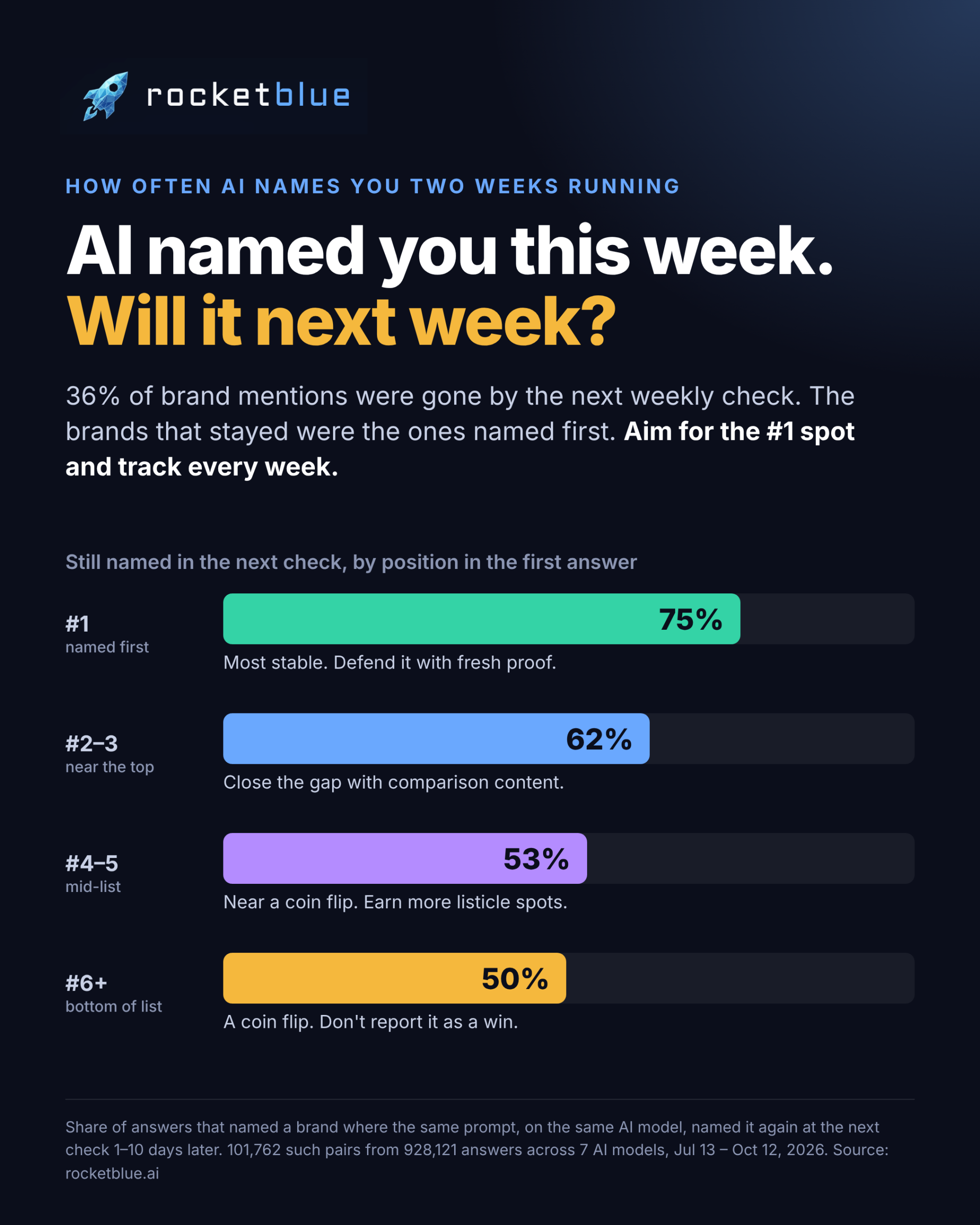
- Want mentions that last? Aim to be named first. Brands named #1 were still there next week 75% of the time, vs 50% for brands at #6 or lower.
- Want an honest report? Track every week, not once. Only 6.9% of question-and-model pairs that named a brand did so at every check.
- Want to know if you really grew? Watch your position, not just whether you were named. Moving from #4–5 to #2–3 raised the odds of staying from 53% to 62%.
- Want to break in? Expect it to take time. When a brand was missing, it showed up at the next check only 5.5% of the time.
- Want to pick your battles? Decision-stage questions held brands better (69%) than awareness questions (62%).
More Than a Third of AI Brand Mentions Disappear Within a Week
We took every answer that named a tracked brand and checked the next run of the same question on the same AI model, one to ten days later (usually seven). There were 101,762 of these pairs. In 65,077 of them (64.0%), the brand was named again. In the other 36.0%, it was gone.
This is not new to us alone. SparkToro found that AI tools rarely give the same list of recommended brands twice, even for the same question (also covered by Search Engine Land). Our data adds the week-to-week view that marketers actually report on.
Being Named First Makes a Mention Far More Likely to Stick
Position in the answer was the strongest signal we found. The higher a brand sat in the list, the more likely it was to be there next time.
| Position in first answer | Pairs | Still named next check | Dropped out |
|---|---|---|---|
| #1 (named first) | 42,871 | 74.8% | 25.2% |
| #2–3 | 27,621 | 61.7% | 38.3% |
| #4–5 | 15,794 | 52.6% | 47.4% |
| #6 or lower | 15,476 | 49.6% | 50.4% |
A brand named sixth or lower is a coin flip. If that is where you show up, a good week in your report may just be luck. A #1 spot is not safe either: one in four still slipped.
Every Model Reshuffles, and Google AI Overviews Reshuffles Most
No single model dominates this dataset. The biggest, Gemini, is 19.3% of the pairs. So the overall number is not driven by one engine. Grok held brands best. Google AI Overviews held them least.
| AI model | Pairs where brand was named | Still named next check | Dropped out | Absent → newly named |
|---|---|---|---|---|
| Grok | 18,096 | 70.7% | 29.3% | 6.3% |
| Gemini | 19,607 | 64.4% | 35.6% | 5.6% |
| ChatGPT | 16,404 | 64.1% | 35.9% | 5.0% |
| Claude | 3,848 | 63.4% | 36.6% | 4.6% |
| Google AI Mode | 11,603 | 62.5% | 37.5% | 6.8% |
| Perplexity | 13,569 | 61.5% | 38.5% | 4.2% |
| Google AI Overviews | 18,635 | 59.6% | 40.4% | 6.1% |
| All models | 101,762 | 64.0% | 36.0% | 5.5% |
Grok is the outlier. Without Grok, the “still named” rate drops from 64.0% to 62.5%. Microsoft Copilot had too few answers that named a brand (55 pairs) to include.
Losses and Gains Cancel Out, Which Hides the Churn
Across all pairs, about 36,685 mentions dropped out and 36,935 new ones appeared. The totals almost match. That means a flat visibility score can hide a lot of movement underneath. You may be losing one question while winning another.
Breaking in is hard. When a brand was not named, it was named at the next check only 5.5% of the time (673,093 pairs). Getting in is slow. Falling out is fast.
Only 7% of Brands Show Up Every Single Week
We also looked at each question on each model as a series. We kept the 71,208 series with at least six checks. In 23,989 of them, the tracked brand was named at least once.
| How often the brand was named | Share of series |
|---|---|
| Every check | 6.9% |
| Half of checks or more (not every one) | 26.3% |
| Fewer than half of checks | 66.8% |
| Only once | 27.3% |
Two out of three “we appear for this question” claims are true less than half the time. More than a quarter were one-offs.
Later-Stage Questions Hold Brands Better Than Early Ones
We split the pairs by buyer journey stage of the question. The later the stage, the more stable the mention.
| Journey stage | Pairs where brand was named | Still named next check | Absent → newly named |
|---|---|---|---|
| Awareness | 22,666 | 61.7% | 4.2% |
| Consideration | 67,522 | 63.3% | 6.2% |
| Decision | 8,509 | 68.7% | 5.5% |
| Post-purchase | 3,061 | 82.4% | 3.7% |
Post-purchase questions (support, setup, “how do I use X”) usually name the brand on purpose, so they stick. Awareness questions are broad and shuffle the most. The rate also held steady over time: 63.1% in late July, 64.9% in August, 63.8% in September and 62.8% in early October.
Decision Table: Where to Focus
| If you care about | Focus on | Then add | Don’t rely on |
|---|---|---|---|
| Reporting AI visibility to leadership | Results across 4+ weekly checks | Your position in each answer | A single run or screenshot |
| Keeping mentions you already have | Questions where you sit at #1–3 | Fresh proof: reviews, comparisons, updated pages | Spots at #6 or lower |
| Winning new questions | Consideration-stage questions (highest gain rate, 6.2%) | Listicle and review placements | Expecting results in one week |
| Picking which models to watch | Google AI Overviews and Perplexity (least stable) | Model-by-model trend lines | One blended score |
| Showing real growth | Moving up the list across weekly checks | Which cited sources changed | A single “mentioned” count |
Checklist: Measure AI Visibility the Right Way
Backed by the data: single checks are noisy, so measure over time.
- Track each key question on each model at least once a week, for at least four weeks, before drawing conclusions.
- Judge each question across several weekly checks, not one answer. Being named once is not a position.
- Check where you appear in each answer, not just whether you were named. #1 held 75% of the time; #6 or lower held 50%.
- Treat any question where you sit at #4 or lower, or appeared only once, as unconfirmed. Don’t count it as a win yet.
- Count a move up the list as progress. Going from #5 to #2 is real, even if “mentioned” looks the same.
Checklist: Move From the Bottom of the List to the Top
Backed by the data: top spots hold better. Recommended practice: the steps below are how teams usually earn them.
- List the questions where you are named at #4 or lower. These are your coin flips.
- For each, look at which sources the AI cites. Find the “best X for Y” lists and review sites that rank your rivals higher.
- Ask to be added or updated in those lists. Send current pricing, features and a short comparison.
- Publish a clear comparison page (“Your brand vs Rival”) with a plain summary table at the top.
- Refresh your own key pages with dates, numbers and customer proof so models have a reason to put you first.
Checklist: Defend the Mentions You Have
Backed by the data: even #1 slips 25% of the time. Recommended practice: keep the sources behind it fresh.
- Find the questions where you are #1 and note the pages the AI cites for them.
- Keep those pages current. Update stats and dates at least every quarter.
- Keep collecting reviews on the sites AI cites in your category.
- Set an alert: if you drop out of a #1 question for two checks in a row, look at what changed in the cited sources.
Want to see how this looks across the market? Check rocketblue’s weekly AI Visibility Stats.
How We Counted
- Window: July 13 to October 12, 2026 (last three full months).
- Data: 928,121 answers to 24,994 tracked buying questions across Grok, Gemini, ChatGPT, Claude, Google AI Mode, Perplexity and Google AI Overviews. Copilot (1,347 answers, 55 pairs with a brand) was left out as too small.
- Pair: two back-to-back checks of the same question on the same model, 1 to 10 days apart (median 7 days). Same-day reruns were not counted as pairs.
- “Still named”: the tracked brand was named in the first answer and named again in the next one.
- Position: where the tracked brand appeared in the list of brands in the first answer.
- Series: all checks of one question on one model in the window; only series with 6+ checks were used.
- Privacy: results are pooled across many brands and organizations. No single brand’s data is shown.
- Limits: some changes may be real (a new review, a site update), not random. We cannot separate the two. Months at the edges (July, October) are partial.
FAQ
Why does ChatGPT mention my brand one week and not the next?
AI answers are built fresh each time. The model may search different pages or pick a different set of brands. In our data, 36% of brand mentions were gone at the next weekly check.
How often should I check my brand’s AI visibility?
At least once a week, for at least four weeks, before drawing conclusions. Only 6.9% of question-and-model pairs that named a brand did so every time.
Does ranking first in an AI answer matter?
Yes. Brands named first were still named at the next check 75% of the time. Brands named sixth or lower stayed only 50% of the time.
Which AI model gives the most consistent brand recommendations?
In our data, Grok held brands best (70.7% still named next check). Google AI Overviews held them least (59.6%).
Is one AI visibility screenshot enough to report results?
No. A single answer is one draw. Look at results across several weekly checks, and pay attention to your position in each answer, not just whether you were named.
What should I change if my brand keeps dropping out of AI answers?
Find the questions where you sit at #4 or lower, check which lists and review sites the AI cites there, and work to get added or moved up in those sources. Then track the same questions weekly to see if your position improves.

Michael Hermon
Before rocketblue, Michael led Innovation and AI at monday.com after exiting his previous startup. He learned to code at 13 at MIT and later attended Columbia’s MBA program.
https://linkedin.com/in/michaelhermon