
Pulse, Posts or Company Page? What 48,273 AI Citations Say About LinkedIn
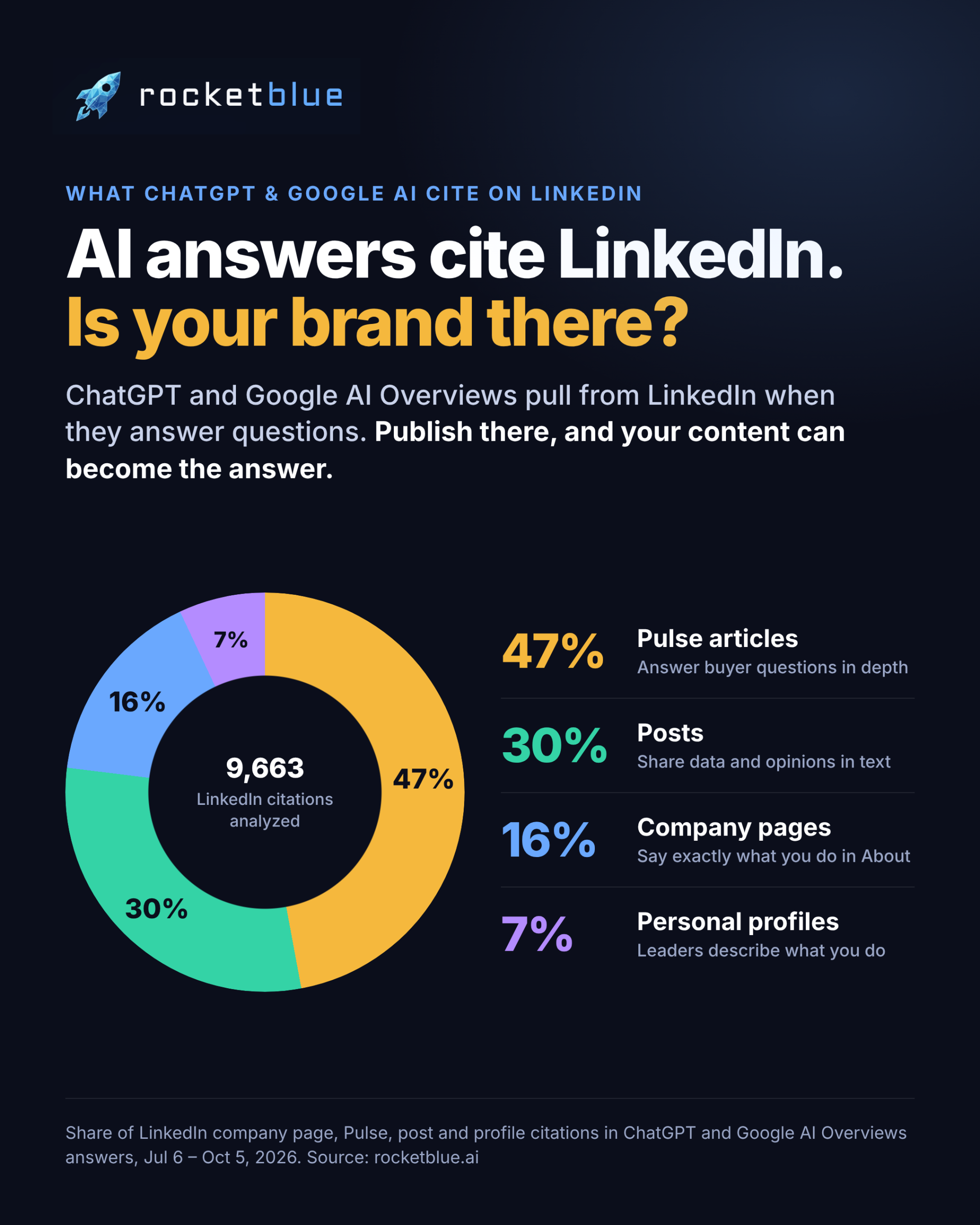
We looked at 48,273 times that AI models cited a LinkedIn page between July 6 and October 5, 2026. Those citations point to 18,489 different pages. The big finding: the LinkedIn page an AI cites depends on which model you ask and what you ask it about. That changes what you should publish.
TL;DR: What to Do With Your LinkedIn Presence
- Want AI to describe your brand correctly? Fix your company page. It is 61% of the LinkedIn links AI uses when someone asks about a specific brand. Use the checklist below.
- Want to show up in Google AI Overviews, AI Mode or Perplexity for general questions? Publish Pulse articles. They are about half of those tools’ LinkedIn citations.
- Want coverage across every model? Add regular posts. They are the second most cited format for almost every model.
- Going after ChatGPT? Don’t count on Pulse. Only 6% of ChatGPT’s LinkedIn citations are Pulse articles. Focus on your company page, posts and your leaders’ personal profiles.
Company Pages Lead Overall, but Grok Drives Most of That
Across all models, company pages are the largest group at 36.4% of LinkedIn citations. Pulse articles are second at 29.1%. Posts are third at 18.3%. Jobs, personal profiles, LinkedIn Learning, LinkedIn’s own help pages and its collaborative article formats make up the rest. None of those passes 4% on its own.
That average is misleading, though. Grok alone produces 46.5% of these LinkedIn citations, and 68.6% of Grok’s LinkedIn citations are company pages. So the “overall” numbers mostly describe Grok.
Take Grok out and the picture flips. For every other model combined, Pulse is 43% of LinkedIn citations, posts are 27%, and company pages are just 8%. If you care about Google’s AI answers or Perplexity, use these numbers, not the overall average.
Pulse articles and company pages have about the same number of different URLs in the data, roughly 6,150 each. Company pages lead the overall count because each one gets cited more often, mostly by Grok.
Each AI Model Picks a Different LinkedIn Format
The table shows each format’s share of that model’s LinkedIn citations, not its share of everything the model cites.
| Model | LinkedIn citations | Company pages | Pulse | Posts | Also notable |
|---|---|---|---|---|---|
| Grok | 22,469 | 68.6% | 13.0% | 8.7% | Jobs, 4.9% |
| AI Overviews | 8,174 | 3.5% | 52.5% | 23.6% | Top content, 7.8% |
| Perplexity | 8,043 | 4.8% | 46.6% | 32.5% | Advice pages, 6.9% |
| AI Mode | 4,860 | 4.3% | 55.0% | 22.4% | Top content, 6.0% |
| ChatGPT | 4,215 | 29.9% | 6.1% | 22.7% | Profiles 12.4%, Learning 8.4%, LinkedIn help and product pages 13.0% |
| Claude | 460 | 2.2% | 33.3% | 59.3% | Posts lead, on a small sample |
Gemini and Copilot are left out because their samples are too small. Gemini cited LinkedIn 45 times, and 93% of those were LinkedIn’s own product or marketing pages. Copilot cited LinkedIn 7 times, all Pulse articles.
Pick Your LinkedIn Format Based on the AI Model You Care About
| If you care about… | Focus on | Then add | Don’t rely on |
|---|---|---|---|
| Google AI Overviews | Pulse articles | Posts | Company page alone |
| Google AI Mode | Pulse articles | Posts | Company page alone |
| Perplexity | Pulse articles | Posts | Company page alone |
| Grok | Company page | Pulse articles | Posts alone |
| ChatGPT | Company page | Posts and leaders’ profiles | Pulse articles |
| Any model, when asked about your brand | Company page | Posts | Pulse articles |
ChatGPT Barely Cites Pulse Articles
ChatGPT is the outlier. Only 6.1% of its LinkedIn citations are Pulse articles. Company pages are 29.9%, posts are 22.7% and personal profiles are 12.4%. LinkedIn Learning is 8.4%, and another 13.0% are LinkedIn’s own help and product pages.
What to do: ChatGPT cites personal profiles more than any other model. Make sure your founders’ and leaders’ profiles describe the company in the same words as your company page. Their headline, About section and current role should all name what the company does and who it serves.
One note on the help and product page group: for AI Overviews, a large share of these citations is just the LinkedIn homepage, cited over and over. That is 441 citations across only 8 URLs.
Brand Questions Pull Company Pages, Category Questions Pull Pulse
People ask AI two kinds of questions. Category questions are general, like “What is the best employee survey tool?” Brand questions are about one company, like “What is Effectory?” The numbers above come from category questions.
We also looked at 22,748 LinkedIn links from answers to brand questions. That set looks very different. Company pages are 61.4%. Posts are 21.2%. Pulse is only 4.4%.
| Model | Pulse: category → brand | Company pages: category → brand |
|---|---|---|
| AI Overviews | 52.5% → 8.2% | 3.5% → 50.4% |
| AI Mode | 55.0% → 7.0% | 4.3% → 66.4% |
| Perplexity | 46.6% → 4.0% | 4.8% → 57.6% |
| Grok | 13.0% → n/a | 68.6% → 74.5% |
The models that lean on Pulse for general questions switch to company pages when the question is about a specific company. A Pulse article can win you a spot in a general answer. Your company page is what AI reads when someone asks about you.
Your LinkedIn Company Page Checklist for AI Search
The data shows AI models cite your company page, and almost always the main company page, not posts on it. That makes the page itself your AI bio. Here is what to check. (The data tells us the page gets cited. The items below are our recommendations for what to put on it.)
- Make your tagline your category, not a slogan. “Employee feedback platform for large companies” beats “Making work better.” AI models often reuse this line as your one-line description.
- Open your About section with a clear definition. Use this pattern: “[Brand] is a [category] that helps [audience] [get an outcome].” Use the same category words your buyers type into AI tools.
- Fill the rest of About with facts, not adjectives. List your products, the markets you serve, your founding year, notable customers and real numbers (customers, countries, team size). AI quotes facts. It skips words like “innovative” and “best-in-class.”
- Fill in Specialties with the words buyers use. Include product categories and use cases, not just your internal product names.
- Match every field to your website and other profiles. Industry, company size, headquarters, founding year and website URL should match your site, G2, Crunchbase and similar profiles. When sources disagree, AI hedges or picks the wrong fact.
- Add every office location. Questions like “best X in the Netherlands” pull location details.
- Update the page the same week anything changes. New name, new product line or new market? Old details linger in AI answers long after you change them elsewhere.
- Test it. Ask ChatGPT, Perplexity and Grok “What is [your brand]?” Compare the answer to your About section. Anything missing or wrong tells you what to rewrite.
How to Write Pulse Articles AI Will Cite
- Use the question as the title. Write the title the way a buyer would ask an AI tool.
- Answer it in the first paragraph. Put the direct answer first, then explain.
- Include your own numbers. Original data gives AI something specific to quote.
- Use subheadings that match follow-up questions. Each section should answer one thing clearly.
- Publish from a leader’s profile, not only the company. Pulse articles are tied to a person, which also strengthens that person’s profile.
How to Write LinkedIn Posts AI Can Use
- Make one clear claim per post. A post that says one thing is easier to cite than a post that says five.
- Put key facts in the text. Don’t hide them only in an image, carousel or PDF. AI models can’t reliably read those.
- Write a descriptive first line. Name the topic and the takeaway up front.
- Post steadily. Posts are 18.3% of all LinkedIn citations and about a fifth of the LinkedIn links in brand answers.
Personal profiles, jobs, advice pages and top-content pages each stay under 4% of all LinkedIn citations. They show up, but they are not the main path. For more on where AI models get their sources, see rocketblue’s AI visibility stats page, updated weekly.
How We Counted
Each row is one cited LinkedIn URL in an AI answer, saved between July 6 and October 5, 2026. The same page can count more than once if models cite it again. We call out distinct URLs where that changes the reading.
We grouped each URL by its path, including country subdomains such as uk.linkedin.com:
- Company pages: linkedin.com/company/… In this data, these are almost all main company pages, not posts on a company page.
- Pulse articles: linkedin.com/pulse/…
- Posts: linkedin.com/posts/…
- Profiles: linkedin.com/in/…
- Top content and advice: LinkedIn’s collaborative article formats, at /top-content/ and /advice/.
- Learning: linkedin.com/learning/ and learning.linkedin.com.
- Help and product pages: LinkedIn’s own homepage, Help, Products and marketing pages such as business.linkedin.com.
Short lnkd.in links are rare in this window (26 citations). We grouped them with LinkedIn’s own site pages because a short link doesn’t show where it leads. An earlier rocketblue analysis found Pulse made up most LinkedIn citations. In this three-month window that is no longer true overall, though Pulse still leads for Google’s AI answers and Perplexity.
FAQ
What should I change on my LinkedIn company page for AI search?
Make your tagline a plain description of your category, open your About section with “[Brand] is a [category] that helps [audience] [outcome],” fill it with facts and numbers, add buyer keywords to Specialties, and make sure every field matches your website. AI models use the company page in 61% of LinkedIn links when describing a brand.
What share of LinkedIn citations are Pulse articles?
29.1% of the 48,273 LinkedIn citations counted from July 6 to October 5, 2026. Company pages are 36.4% and posts are 18.3%. Without Grok, Pulse rises to about 43%.
Which AI models cite LinkedIn Pulse?
Google AI Mode (55.0% of its LinkedIn citations), Google AI Overviews (52.5%) and Perplexity (46.6%). Grok is at 13.0%. ChatGPT is at 6.1%.
Which LinkedIn pages does ChatGPT cite?
Mostly company pages (29.9%), posts (22.7%) and personal profiles (12.4%). It rarely cites Pulse articles (6.1%).
Do AI models cite LinkedIn company pages?
Yes. Company pages are the largest LinkedIn type overall, mostly because Grok sends 68.6% of its LinkedIn citations there. They are also 61.4% of LinkedIn links in answers that describe a brand.
Should a brand publish Pulse articles or posts on LinkedIn?
Both, if you want coverage across models. Pulse is the stronger format for Google’s AI answers and Perplexity. Posts are the steady runner-up and matter more when AI describes a brand. Keep the company page current too, because that is what gets cited when the question is about you.

Michael Hermon
Before rocketblue, Michael led Innovation and AI at monday.com after exiting his previous startup. He learned to code at 13 at MIT and later attended Columbia’s MBA program.
https://linkedin.com/in/michaelhermon