
Named, but Not Recommended? What 124k AI Brand Mentions Show About Sentiment
We looked at 923k AI answers to tracked buyer questions between July 14 and October 13, 2026. A tracked brand was named in 124k of them. We then checked how each answer talked about that brand. The big finding: AI almost never trashes a brand. Only 0.9% of mentions were negative. The real gap is between being praised and just being listed, and that gap grows the further down the list you sit.
TL;DR: What to Do About How AI Talks About Your Brand
- Want AI to recommend you, not just list you? Track neutral mentions, not just negative ones. 23.1% of mentions are neutral and only 0.9% are negative. That is 26 neutral mentions for every negative one. Use the checklist below.
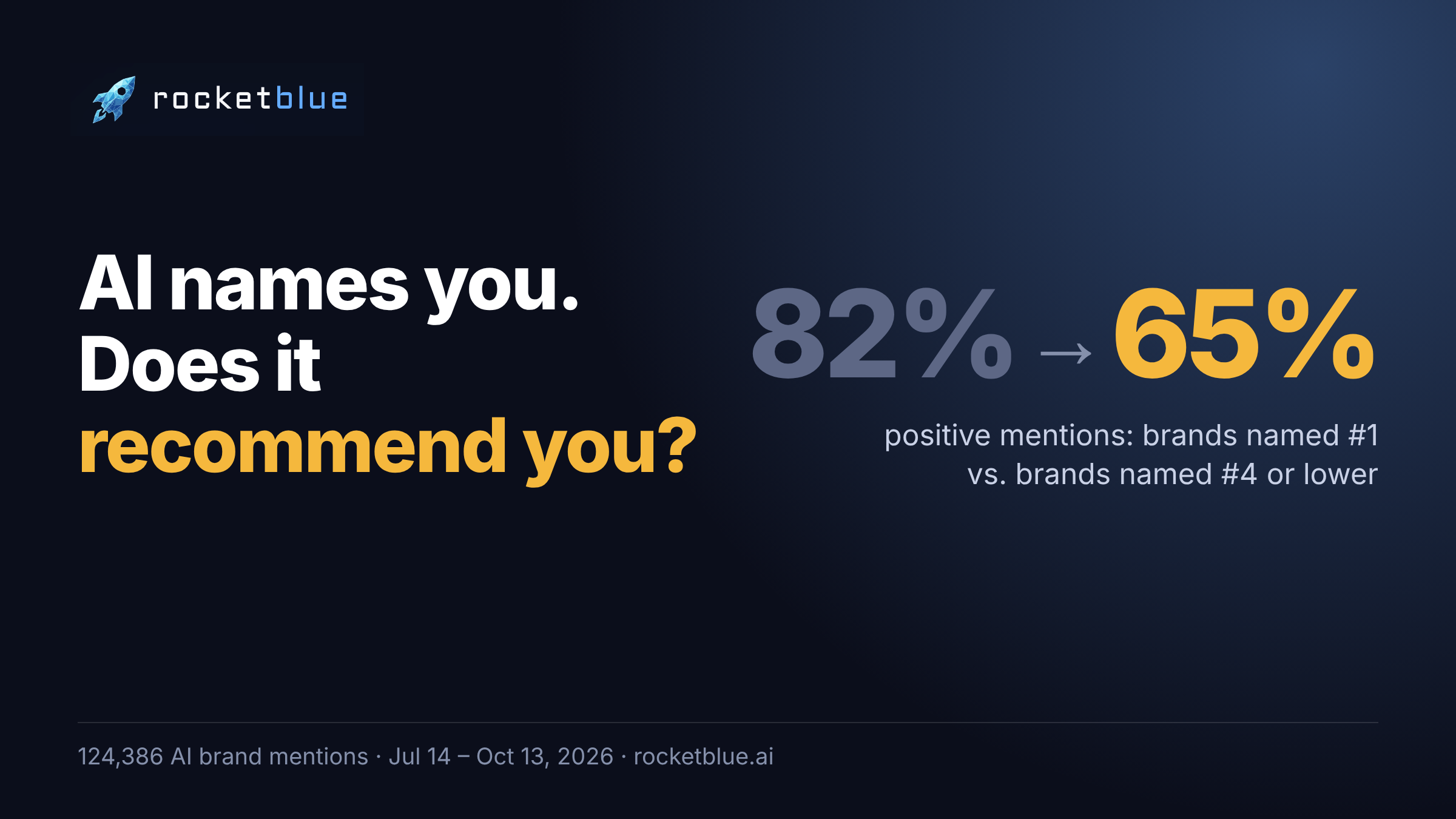
- Want warmer mentions? Work on your position in the list. Brands named first are described positively 82.2% of the time. Brands named fourth or lower get 64.8%.
- Selling into buyers who are about to choose? Watch decision-stage questions. 2.23% of mentions there are negative, about 4 times the rate in consideration questions (0.58%). ChatGPT (3.89%) and Grok (3.28%) are the most critical.
- Care about Perplexity? Expect plain listings. Only 63.2% of its mentions are positive, the lowest of any major model. Google AI Mode is at 84.6%.
- Care about Claude? Check what it says when asked about you directly. In 38.9% of its brand-question answers, it gave nothing we could score as positive or negative.
Only 0.9% of AI Brand Mentions Are Negative. Neutral Is the Real Problem
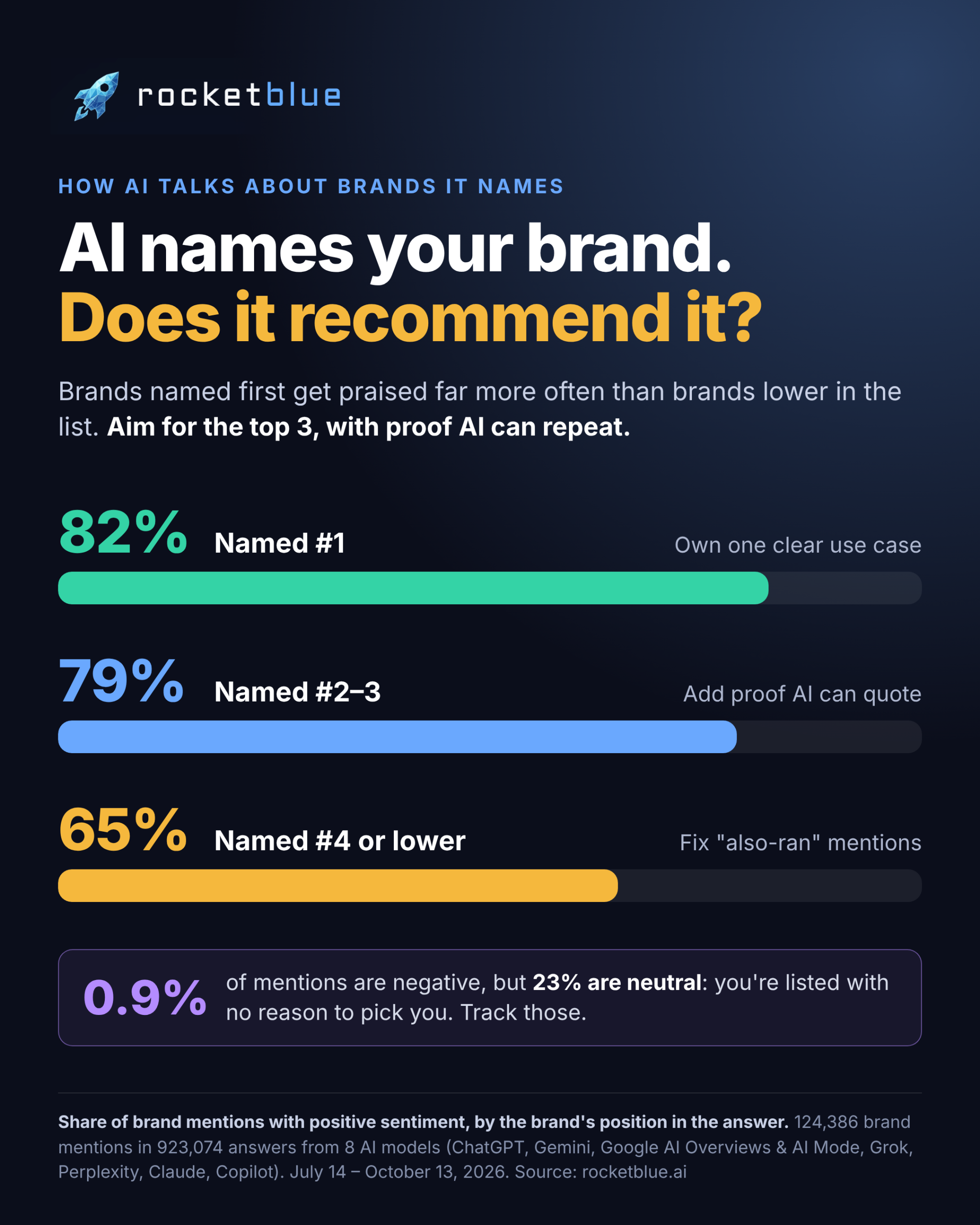
Out of 124,386 brand mentions, 76.0% were positive, 23.1% were neutral and 0.89% were negative. Negative mentions are rare. If you only set alerts for bad press in AI answers, you will see almost nothing.
The neutral group is the one to watch. A neutral mention is when the AI names your brand but doesn’t say why anyone should pick it. Think “Other options include A, B and your brand.” You are in the answer, but the buyer gets no reason to click. There are 26 neutral mentions for every negative one.
Being named at all is still the first hurdle. A tracked brand showed up in 13.5% of all answers. If you are not there yet, start with visibility. Once you are named, the next job is turning neutral mentions into positive ones.
The Higher You Rank in the Answer, the Warmer AI Sounds
Position and tone go together. When a brand was named first, 82.2% of those mentions were positive. At second or third, it was 78.6%. At fourth or lower, it fell to 64.8%. That is a 17-point drop from the top spot to the bottom of the list.
Brands named first make up 42.9% of all mentions in our data, so this is not a small group. The pattern holds for every major model. The drop is steepest for ChatGPT (83.6% at #1 to 56.7% at #4 or lower) and Grok (84.0% to 59.7%). Gemini is the one model where second and third place (84.8%) sound slightly warmer than first (81.9%).
This doesn’t prove that ranking higher causes better tone. It may work the other way: AI puts the brands it likes most at the top. Either way, the fix is the same. Give AI clear reasons to prefer you, and both your position and your tone tend to improve.
Perplexity Is the Most Neutral Model. AI Mode and Claude Are the Warmest
No single model dominates this data. The biggest, Gemini, is 19.0% of all mentions, so the overall numbers are a fair average. The models still differ a lot in tone.
| Model | Brand mentions | Positive | Neutral | Negative | Positive at #1 | Positive at #4+ |
|---|---|---|---|---|---|---|
| Google AI Mode | 13,734 | 84.6% | 14.7% | 0.73% | 90.0% | 77.3% |
| Claude | 4,401 | 83.5% | 15.5% | 0.93% | 90.6% | 74.0% |
| Gemini | 23,671 | 81.2% | 18.0% | 0.75% | 81.9% | 76.3% |
| Google AI Overviews | 23,356 | 77.1% | 22.0% | 0.93% | 82.3% | 68.6% |
| Grok | 22,407 | 74.1% | 24.6% | 1.31% | 84.0% | 59.7% |
| ChatGPT | 20,406 | 73.9% | 25.1% | 1.01% | 83.6% | 56.7% |
| Perplexity | 16,340 | 63.2% | 36.4% | 0.40% | 70.7% | 52.1% |
| All models | 124,386 | 76.0% | 23.1% | 0.89% | 82.2% | 64.8% |
Perplexity stands out. More than a third of its mentions (36.4%) are neutral, and it is also the least likely to be negative (0.40%). It tends to list options without judging them. Grok is the most likely to be negative (1.31%). Copilot is left out of the table because it named a tracked brand only 71 times.
Pick Your Focus Based on the Model and Moment You Care About
| If you care about | Focus on | Then add | Don’t rely on |
|---|---|---|---|
| Perplexity | Clear, quotable reasons to pick you (it is 36.4% neutral) | Third-party reviews and comparisons it can cite | Being listed as enough |
| ChatGPT or Grok | Moving into the top 3 (positive drops to 56.7% and 59.7% at #4+) | Answers to buyer objections on your own site | A low negative rate overall; it is highest here at decision stage |
| Google AI Mode and AI Overviews | Staying in the answer; tone is already warm (84.6% and 77.1% positive) | Pages that match “best X for Y” questions | Tone alone to win clicks |
| Claude | What it says about you when asked directly (38.9% no scorable view) | Plain facts about your product on pages it can find | Category answers alone; they are warm (83.5%) but rare |
| Buyers about to choose | Decision-stage questions (2.23% negative) | Pricing, support and limits explained honestly | Awareness-stage results to judge your reputation |
Decision-Stage Questions Carry 4 Times the Negative Risk
We split answers by the buyer journey stage of the question. The share of answers that name a brand rises as buyers get closer to buying. The tone changes too.
| Journey stage | Answers | Brand named | Positive | Negative |
|---|---|---|---|---|
| Awareness | 260,022 | 9.9% | 66.8% | 1.30% |
| Consideration | 572,796 | 14.6% | 78.6% | 0.58% |
| Decision | 67,976 | 16.9% | 78.6% | 2.23% |
| Post-purchase | 19,322 | 17.7% | 77.2% | 0.35% |
Two things stand out. Awareness questions, the early “what is” and “how do I” questions, have the coolest tone at 66.8% positive. Brands get mentioned there in passing, not recommended. And decision-stage questions have the highest negative rate at 2.23%. These are questions like “Is X worth it?” or “X vs Y pricing.” That is when AI is most willing to point out a downside, and it is also when the buyer is closest to spending money.
Within decision-stage answers, ChatGPT was negative 3.89% of the time (1,980 mentions) and Grok 3.28% (2,136 mentions). Perplexity was lowest at 0.92% (1,530 mentions).
Answers That Name Only Your Brand Are the Least Positive
You might expect that being the only brand in an answer is the best case. In our data it is the worst. When an answer named just one brand, only 57.0% of those mentions were positive and 2.79% were negative. When an answer named four to six brands, 79.7% were positive and 0.58% negative.
We did not test why. One likely reason is that single-brand answers are often narrow: the AI is answering a specific question that happens to involve one brand, sometimes with a caveat. So don’t assume a solo mention is a recommendation. Read those answers.
Brand Questions Look Similar, but Claude Often Has Nothing to Say
We also checked the other side: questions about a specific brand, such as “Is X good for small teams?” Across 134,332 of these answers, 122,742 gave enough detail to score. Of those, 73.5% scored “Great” or “Exceptional,” and only 1.19% scored “Poor” or “Bad.” That is close to the 76.0% positive rate in category questions.
The big difference is how often a model gives nothing to score. Claude did that in 38.9% of its 5,968 brand-question answers. Perplexity did it in 14.9%. Google AI Mode did it in just 1.5%. Some of these answers say the model couldn’t find information. Others just give a flat fact with no view either way. Both mean the model isn’t making a case for you.
Negative Mentions Are Still Rare, but They Tripled Over the Window
The positive rate stayed steady between 75% and 79% each month. The negative rate rose from 0.45% (July 14 to 31) to 0.58% in August, 1.20% in September and 1.45% in October (1 to 13). That is still rare, but it more than tripled. Part of this may be a change in which questions are tracked, so treat it as a trend to watch, not a verdict. Our AI Visibility Stats page tracks broader shifts in AI search each week.
Checklists to Turn Mentions Into Recommendations
The numbers above come from our data. The steps below are recommended practice based on those numbers, not things we tested one by one.
1. Find and Fix Your Neutral Mentions
- Pull every AI answer that names you. Sort them into positive, neutral and negative. Expect about one in four to be neutral.
- For each neutral answer, write down the question and the brands named above you. Those are your real competitors for that question.
- Write one sentence that says who you are best for, such as “Best for teams under 50 that need setup in a day.” Put it on your homepage, product page and About page.
- Back that sentence with proof AI can repeat: a number, a named customer type, a result. “Cuts onboarding from 2 weeks to 3 days” beats “fast and easy.”
- Follow Google’s advice on helpful, people-first content. Pages that clearly answer the buyer’s question are easier for AI to quote.
2. Move Up the List
- Find the questions where you are named fourth or lower. Positive tone drops to 64.8% there, and to 56.7% on ChatGPT.
- Pick one use case per question that you can own, such as “for agencies” or “for Shopify stores.” Build a page for it.
- Get into the “best X for Y” lists that AI reads. Ask reviewers and partners to say which use case you are best at, not just that you exist.
- Ask happy customers for reviews that name a specific result. Google’s guidance on high-quality reviews explains what makes a review useful.
3. Protect Your Decision-Stage Answers
- Track at least 10 decision questions per product: “Is [brand] worth it?”, “[brand] vs [competitor]”, “[brand] pricing”, “[brand] reviews”.
- Check ChatGPT and Grok first. They were negative 3.89% and 3.28% of the time on these questions.
- For each downside AI mentions, publish an honest answer. If the complaint is “expensive,” explain what is included and who it is worth it for.
- Keep pricing, limits and support details current on your site. Old facts are an easy way to get a negative mention.
- Publish your own comparison pages that are fair to competitors. A balanced page is more useful to buyers and gives AI fairer material to quote than a one-sided sales page.
4. Give Claude and Perplexity Something to Work With
- Ask Claude and Perplexity 5 direct questions about your brand. Note any answer that says it can’t find information or gives no view.
- Make sure the basic facts (what you do, who it’s for, price range, where you operate) are written in plain text on pages that load without a login.
- Add an FAQ to your product pages that answers the exact questions buyers ask about you.
- Re-check in 4 weeks. Brand mentions shift often, as our week-to-week drop-out study showed.
How We Counted
- Window: July 14 to October 13, 2026.
- Category questions: 923,074 answers from eight AI models to 25,139 tracked prompts across 423 brands. A “brand mention” is an answer that names the tracked brand for that prompt: 124,386 in total.
- Sentiment: each mention is labeled positive, neutral or negative based on how the answer talks about the tracked brand.
- Position: the brand’s place in the order brands appear in the answer. #1 means named first.
- Brands per answer: the number of brands named in the same answer.
- Brand questions: 134,332 answers to questions about a specific brand. Each is scored from “Poor” to “Exceptional,” or marked as having no scorable view. “No AI Overview returned” answers are left out.
- Small samples: Copilot (71 mentions) is left out of model comparisons. Prompts with no journey stage or a rare custom stage (2,958 answers in total) are left out of the stage table.
- Privacy: all numbers are aggregates across brands. We don’t show any single brand’s results.
FAQ
What should I change so AI recommends my brand instead of just listing it?
Give AI a clear, provable reason to pick you. State who you are best for in one sentence, back it with a number or result, and get reviews and “best X for Y” lists to repeat it. 23.1% of AI brand mentions are neutral, which means the brand is named with no reason to choose it.
How often does AI say negative things about brands?
Rarely. Only 0.89% of 124,386 brand mentions were negative between July 14 and October 13, 2026. The rate is higher for decision-stage questions (2.23%) and rose from 0.45% in late July to 1.45% in early October.
Which AI model is most positive about brands?
Google AI Mode (84.6% positive) and Claude (83.5%). Gemini is at 81.2%. Perplexity is the most neutral at 63.2% positive and 36.4% neutral.
Does ranking first in an AI answer mean better sentiment?
They go together. Brands named first are positive 82.2% of the time. Brands named fourth or lower are positive 64.8% of the time. The link could run either way, but both improve when AI has clear reasons to prefer you.
Why does ChatGPT mention my competitors’ downsides?
It happens most on decision-stage questions like pricing and comparisons. ChatGPT was negative in 3.89% of decision-stage mentions, the highest of any major model. Publishing honest, current answers to common objections gives it better material to use.
How do I track AI brand sentiment?
Track a fixed set of buyer questions across models every week. Record whether you are named, your position, and whether the mention is positive, neutral or negative. Include decision-stage questions and direct questions about your brand, since that is where the biggest differences show up.

Michael Hermon
Before rocketblue, Michael led Innovation and AI at monday.com after exiting his previous startup. He learned to code at 13 at MIT and later attended Columbia’s MBA program.
https://linkedin.com/in/michaelhermon