
79% vs 18%: What 10.2 Million AI Citations Show About When AI Uses Your Own Website
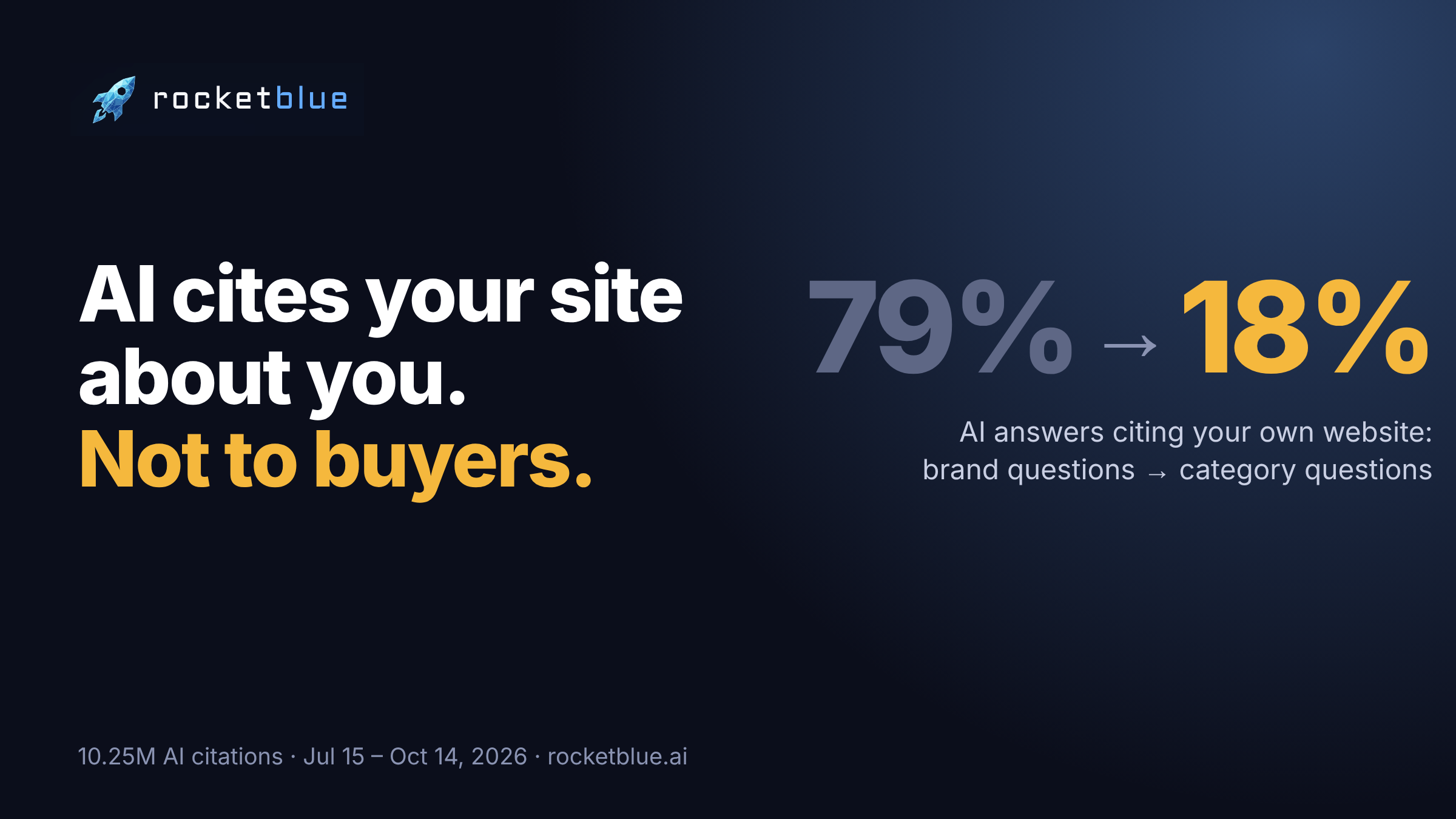
We looked at 10,250,952 citations in 816,114 AI answers from eight AI models between July 15 and October 14, 2026, for about 400 tracked brands. We asked one simple question: how often does the AI cite the brand’s own website? The answer depends on what the person asked. When someone asks about your brand, AI cites your site in 79% of answers. When someone asks for the best option in your category, that drops to 18%.
TL;DR: What to Do With Your Own Website
- Want AI to describe you correctly? Your own site already does most of the work. 79% of answers about a brand cite its website. Make sure the facts there are clear, current and easy to quote. Use the checklist below.
- Want to be named when buyers compare options? Don’t count on your site alone. Only 3% of citations in category answers point to the brand’s own site. The other 97% come from other websites, so get covered on the listicles, reviews and forums AI reads.
- Want your site to count in category answers? Build pages that answer “best X for Y” questions. When a category answer cites your site, it names you 51% of the time. When it doesn’t, just 7%.
- Going after ChatGPT? It leans on your site the most for brand questions (89% of answers) but the least for category questions (13%). Your site shapes how ChatGPT describes you, not whether it picks you.
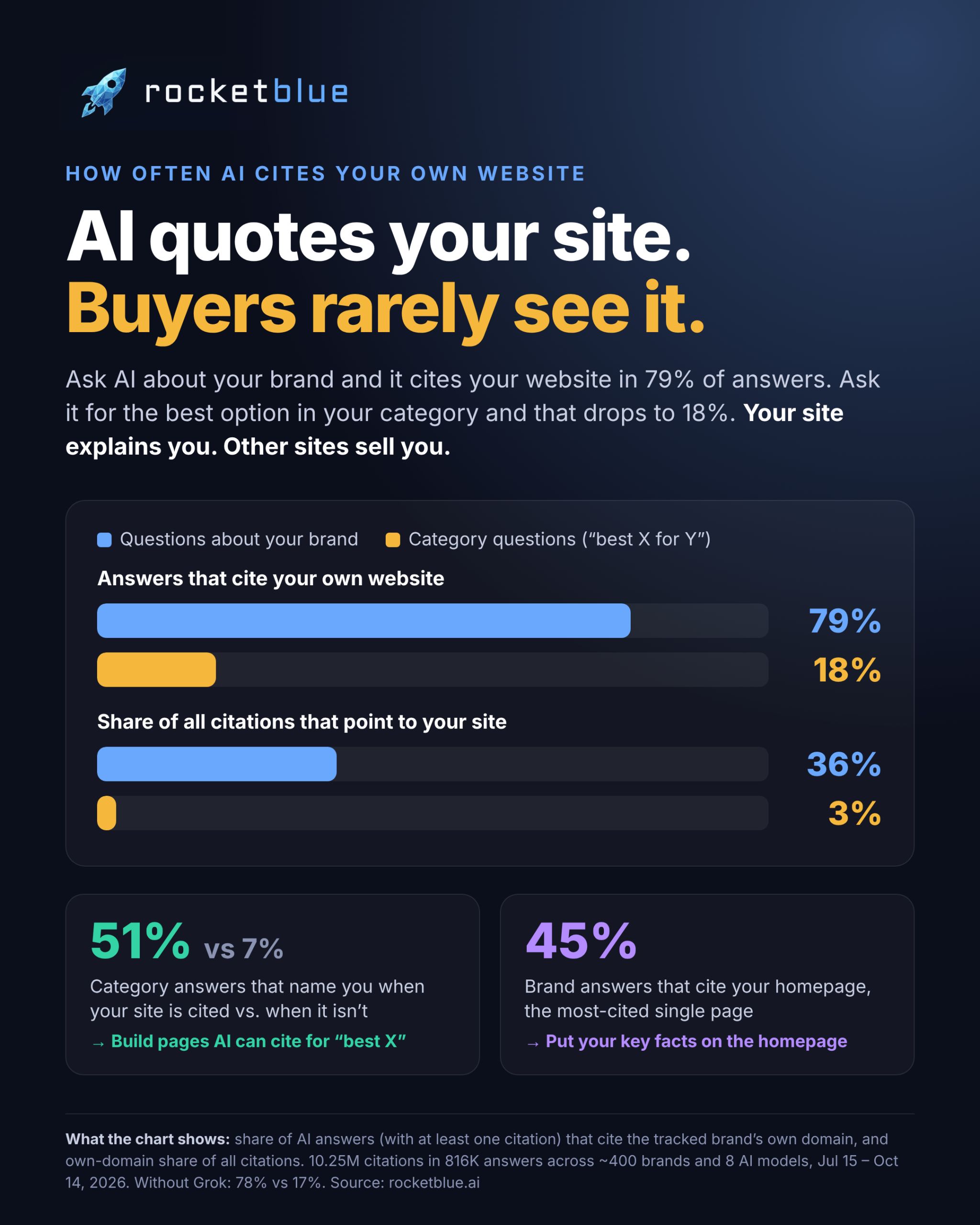
AI Cites Your Site When It Describes You, Not When It Recommends You
We split the data into two kinds of questions. Brand questions ask an AI to describe one brand, like “What is [brand] known for?” Category questions are the ones buyers ask before they have a shortlist, like “What is the best project tool for small teams?”
The gap between the two is large:
- Brand questions: 79.4% of answers cite the brand’s own website at least once. 35.7% of all citations in these answers point to the brand’s own site.
- Category questions: 17.7% of answers cite the tracked brand’s own site. Only 2.9% of all citations point there.
Put simply, when AI explains who you are, it reads you. When AI decides who to recommend, it mostly reads other people writing about you. That matches what we found about listicles and reviews in AI citations: third-party pages drive who gets named.
Grok Produces 4 in 10 Citations, and the Gap Holds Without It
Grok cites far more links per answer than other models. It produced 42.1% of the brand-question citations and 41.3% of the category-question citations in this data. So we checked the numbers without Grok.
Without Grok, 77.5% of brand answers cite the brand’s own site, and 41.3% of brand-question citations point there. In category answers it is 16.5% of answers and 3.4% of citations. The story does not change: about 78% vs 17%.
Grok matters most for the “share of citations” number. Grok cites your own site in 92.7% of brand answers, but because it also cites dozens of other pages per answer, your site is only 28.0% of its brand-question citations.
Being Cited in a Category Answer Goes With Being Named
In category answers where the AI cited the brand’s own site, the brand was named in the answer 51.1% of the time. In category answers that did not cite the brand’s site, it was named just 7.3% of the time. Without Grok, it is 51.4% vs 7.0%.
Flip it around: of all category answers that named the brand, 60.1% also cited its website. So 4 in 10 times AI recommends you, it does so without linking to you at all. It is using other sources.
One caution. This is a link, not proof of cause. AI may cite your site because it already decided to name you. Still, every model shows the same pattern, so a page on your site that AI can cite for a category question is a real advantage.
Every Model Uses Your Site Differently
“Brand answers citing your site” is the share of brand-question answers (with at least one citation) that cite the brand’s own domain. “Named when cited / not cited” is the share of category answers that name the brand, split by whether the brand’s site was cited.
| Model | Brand answers citing your site | Your site’s share of brand citations | Category answers citing your site | Named when cited / not cited |
|---|---|---|---|---|
| ChatGPT | 88.8% | 51.7% | 13.0% | 55.4% / 6.2% |
| Perplexity | 78.6% | 34.1% | 17.3% | 35.3% / 5.2% |
| Google AI Overviews | 78.4% | 37.6% | 19.9% | 51.3% / 6.8% |
| Google AI Mode | 77.7% | 37.6% | 20.1% | 52.7% / 8.2% |
| Gemini | 63.2% | 37.6% | 12.6% | 68.3% / 9.5% |
| Claude | 83.8% | 35.1% | 32.1% | 57.4% / 4.7% |
| Grok | 92.7% | 28.0% | 26.1% | 49.7% / 10.2% |
| All models | 79.4% | 35.7% | 17.7% | 51.1% / 7.3% |
A few things stand out:
- ChatGPT trusts your site most when describing you. Half of its brand-question citations are your own pages. But it cites your site in only 13% of category answers.
- Claude is the most open to brand sites in category answers. 32% of its category answers cite the tracked brand’s site, more than double ChatGPT. Claude’s sample is smaller (1,674 brand answers, 13,353 category answers), but both are well above our 300 minimum.
- Gemini cites your site least in both question types. Only 63% of its brand answers cite the brand’s site. That makes third-party profiles more important for Gemini.
- Google AI Overviews and AI Mode behave almost the same: about 78% for brand questions and 20% for category questions.
Your Homepage Is the Page AI Cites Most Often About You
For brand questions, we sorted the brand’s own cited pages by URL path. Here is the share of brand answers that cite each kind of page at least once:
| Page on your site | Brand answers citing it | Share of your own-site citations |
|---|---|---|
| Homepage | 45.2% | 12.5% |
| Blog, news, guides and case studies | 34.4% | 23.1% |
| About, company, team, press and contact | 28.9% | 11.3% |
| Product, features, pricing and docs | 28.9% | 15.2% |
| Other pages (could not be labeled from the URL) | 51.1% | 37.9% |
The homepage reaches the most answers, but each answer usually cites it once. Blog and guide pages get cited more times in total. Many “other” pages are blog posts or service pages that sit at the root of a site, like /our-approach, so content probably matters even more than the table shows.
What to Fix First Depends on Your Goal
| If you care about | Focus on | Then add | Don’t rely on |
|---|---|---|---|
| How AI describes your brand | Homepage and About page facts | Blog posts and guides that explain what you do | Third-party profiles alone, since 79% of brand answers cite your site |
| Being named for “best X” questions | Coverage on listicles, reviews and forums | A comparison or “best X for Y” page on your own site | Your homepage. Only 3% of category citations are brand sites |
| ChatGPT | Clear, quotable facts on your own site | Third-party mentions for category questions (it cites brand sites in 13% of them) | Your site to get you recommended |
| Gemini | Third-party profiles and reviews | Your About and product pages | Your own site doing the work (63% of brand answers) |
| Claude | Your own site, for both question types | Guides that answer category questions directly | Big directories only |
Brand Questions vs Category Questions Over Time
The pattern was steady across the three months. Brand answers citing the brand’s own site were 78.8% (July 15 to August 14), 77.8% (August 15 to September 14) and 81.7% (September 15 to October 14). Without Grok, the brand site’s share of brand-question citations rose from 38.7% to 40.2% to 45.5%. AI is leaning a bit more on your own site when it describes you.
Checklist: Make Your Site the Best Source About You
The data shows AI reads your own site for brand questions, and reads the homepage most. The steps below are recommended practice based on that finding.
- Put a one-paragraph “what we do” summary on your homepage. Say who you serve, what you sell and where. Example: “Acme makes scheduling software for dental clinics in the US and Canada.”
- Keep key facts on one About page. Founding year, headquarters, leadership, customer count and pricing model. Write them as plain sentences, not only in images or sliders.
- Add Organization structured data. Use Google’s Organization markup guide and the schema.org Organization type for name, logo, URL and social profiles.
- Make sure AI crawlers can read your pages. Check your robots.txt and that key text loads without JavaScript. Google explains how its AI features use your site in its AI features guide.
- Fix old facts. Search your site for outdated pricing, product names or team pages. AI will quote them.
- Ask AI about yourself. Ask ChatGPT, Gemini and Perplexity “What is [your brand]?” and check which of your pages they cite.
Checklist: Get Named When Buyers Compare Options
Backed by the data: category answers mostly cite other sites (97% of citations), and answers that cite your site name you far more often (51% vs 7%). The steps are recommended practice.
- List the 20 category questions that matter. Example: “best CRM for real estate agents,” “Asana alternatives for agencies.”
- Check which sites AI cites for them. Note the listicles, review sites and forums that keep showing up.
- Get onto those pages. Pitch the authors, update your review profiles and answer questions in relevant forums.
- Build one page per key use case on your site. Title it the way buyers ask, like “Scheduling software for dental clinics.” Include who it is for, a short comparison and real numbers.
- Publish honest comparison pages. “[You] vs [competitor]” and “best tools for [use case]” pages give AI something to cite in category answers.
- Track it weekly. Watch both “named” and “cited” for your category questions. Our AI visibility stats page shows the wider citation trends.
How We Counted
- Window: July 15 to October 14, 2026.
- Data: 9,022,184 citations in 710,630 category answers and 1,228,768 citations in 105,484 brand answers, from rocketblue’s tracking of about 400 brands that have a website on file. Models: ChatGPT, Perplexity, Google AI Overviews, Google AI Mode, Gemini, Claude, Grok and Microsoft Copilot.
- Own site: a citation counts as “own site” when its domain matches the tracked brand’s website domain or one of its subdomains (for example,
help.brand.comcounts forbrand.com). Sister brands on other domains do not count. - Category questions: answers to prompts a brand tracks about its market. “Own site” means the site of the brand tracking that prompt. Brand questions: answers where the AI was asked to describe one brand.
- Answer share: the share of answers with at least one citation that cite the brand’s own site at least once. Citation share: own-site citations divided by all citations.
- Named: whether rocketblue detected the tracked brand in the answer text.
- Page types: sorted by URL path keywords after removing language folders like
/en/. URLs with no clear keyword are “other.” - Small samples: Microsoft Copilot is left out of model comparisons. All numbers are aggregates; we do not show any single brand’s data.
FAQ
Does ChatGPT cite my company website?
Yes, mostly when someone asks about your brand. In our data, ChatGPT cited the brand’s own site in 89% of answers about that brand, but in only 13% of answers to category questions like “best X for Y.”
Why doesn’t AI cite my website when people ask for the best product in my category?
For category questions, AI leans on third-party pages such as listicles, reviews and forums. Only about 3% of citations in those answers point to the tracked brand’s own site.
Which page on my website does AI cite most?
The homepage. It was cited in 45% of brand answers. Blog posts and guides were cited in 34%, and About and product pages in about 29% each.
Does getting my site cited help me get recommended by AI?
It goes together. Category answers that cited the brand’s site named the brand 51% of the time, compared with 7% when they did not. That is a correlation, not proof that one causes the other.
Which AI model relies most on brand websites?
For brand questions, ChatGPT: half of its citations in those answers are the brand’s own pages. For category questions, Claude cited the brand’s own site most often, in 32% of answers.
What should I change on my website for AI search?
Put clear, quotable facts on your homepage and About page, add Organization structured data, and build pages that answer the “best X for Y” questions buyers ask. Then work on getting covered by the third-party sites AI cites for your category.

Michael Hermon
Before rocketblue, Michael led Innovation and AI at monday.com after exiting his previous startup. He learned to code at 13 at MIT and later attended Columbia’s MBA program.
https://linkedin.com/in/michaelhermon