
Listicles Get You Named, Reviews Get You Described: What 9.7 Million AI Citations Show
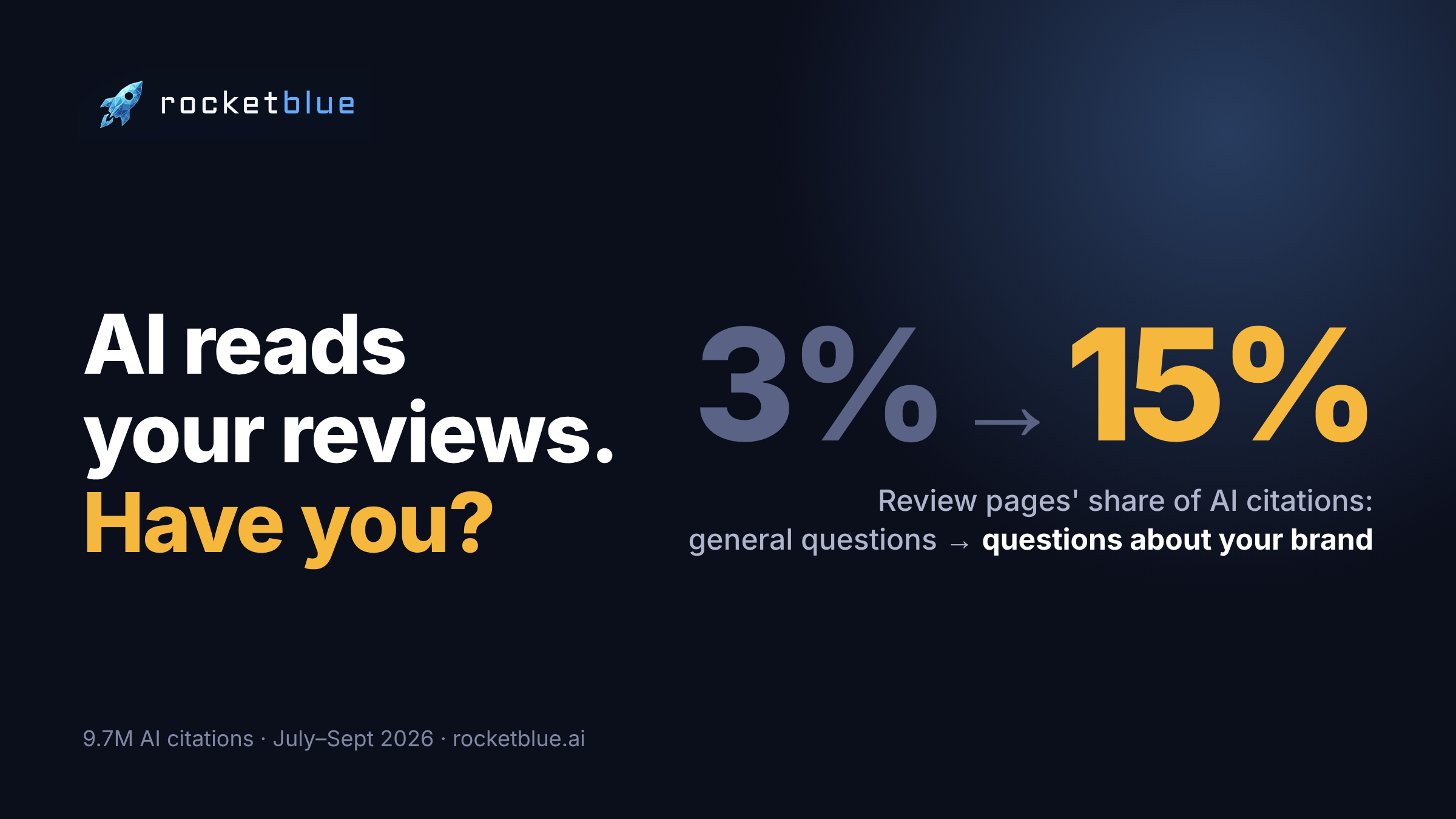
We sorted 9.7 million AI citations from July 1 to September 30, 2026 by page type. The big finding: AI uses different pages for different jobs. When someone asks a general “best X” question, AI leans on listicles and blogs. When someone asks about your brand by name, review pages jump from 3.3% to 14.6% of what AI cites. So the pages that get you named are not the pages that decide how you are described.
TL;DR: What to Do About Review Sites and Listicles
- Want AI to describe your brand well? Fix your review profiles. Review pages are 14.6% of citations in brand answers, 4.4 times their share in general answers. Trustpilot alone is 36% of those review citations. Use the checklist below.
- Want to be named in “best X” answers? Get onto listicles and comparison pages. Together they are 6.8% of category citations, and 8.1% when buyers are comparing options.
- Want a source you fully control? Tighten your homepage. Homepages are 16.9% of category citations and 20.5% of brand citations, the biggest single page type in brand answers.
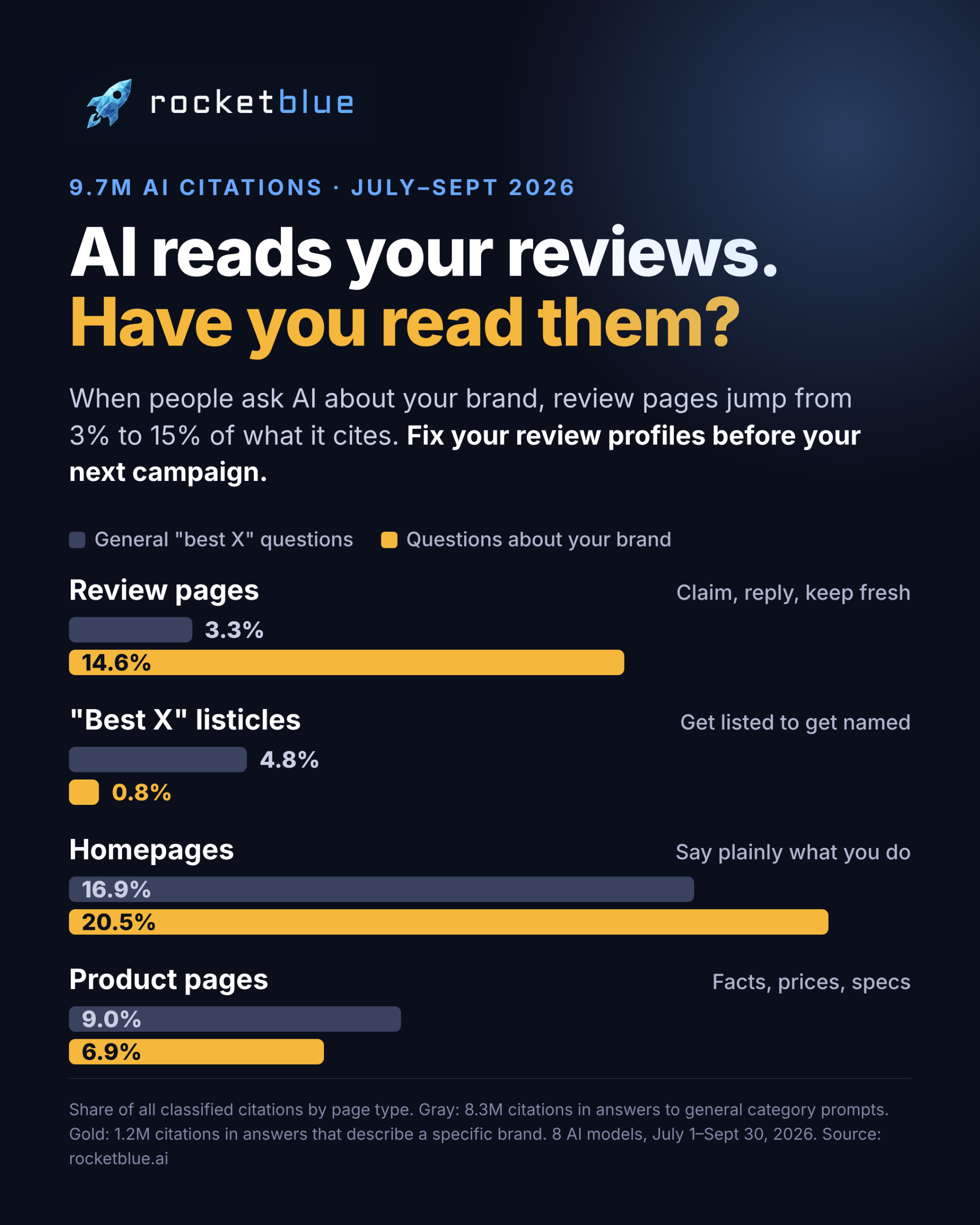
- Don’t count on listicles to describe you. They fall to 0.8% of citations when the question is about one brand.
Review Pages Get 4.4 Times More Weight When AI Talks About Your Brand
People ask AI two kinds of questions. Category questions are general, like “What is the best payroll software for small teams?” Brand questions are about one company, like “Is [Brand] any good?” or “What is [Brand] known for?”
In 8.3 million classified citations from category answers, review pages are 3.3%. In 1.2 million classified citations from brand answers, they are 14.6%. That is 1 in every 7 links AI uses when it describes a company.
Listicles move the other way. They are 4.8% of category citations but only 0.8% of brand citations, about six times lower. A “Top 10 tools” article helps AI build a shortlist. It is rarely what AI reads when it explains who you are.
| Page type | Category questions | Brand questions | Change |
|---|---|---|---|
| Review pages | 3.3% | 14.6% | 4.4x higher |
| Listicles (“best X”) | 4.8% | 0.8% | About 6x lower |
| Product comparisons (“X vs Y”) | 2.0% | 1.9% | About the same |
| Marketplace listings | 4.8% | 2.2% | About half |
| Homepages | 16.9% | 20.5% | 1.2x higher |
| Product pages | 9.0% | 6.9% | Lower |
| Blogs, articles and guides | 45.3% | 33.6% | Lower, still the largest group |
Comparison pages are worth a note. They hold steady at about 2% in both question types. A good “[Your brand] vs [Competitor]” page can help in both places.
Grok Is a Third of the Data, and the Pattern Holds Without It
Grok produced 34.2% of the category citations and 35.7% of the brand citations in this window, so we checked whether it drives the result. It does not. With Grok removed, review pages go from 2.5% of category citations to 14.5% of brand citations, a 5.7x jump. Listicles go from 4.4% to 0.7%. The gap actually gets wider.
Grok’s citations also ramp up in August. In July it was a tiny share of the data. That is why we report the result both ways.
Every Major AI Model Leans on Reviews for Brand Answers
The table shows each page type’s share of that model’s classified citations, first for category questions and then for brand questions.
| Model | Citations (category / brand) | Review pages | Listicles | Homepages |
|---|---|---|---|---|
| Grok | 2.84M / 430K | 4.8% → 14.9% | 5.6% → 1.0% | 11.3% → 14.9% |
| ChatGPT | 1.60M / 276K | 3.2% → 15.6% | 4.1% → 0.6% | 18.0% → 22.1% |
| Perplexity | 1.32M / 194K | 3.4% → 18.4% | 6.6% → 0.9% | 14.3% → 21.9% |
| Google AI Overviews | 1.15M / 147K | 1.6% → 10.1% | 2.7% → 0.7% | 25.8% → 28.2% |
| Google AI Mode | 674K / 55K | 1.4% → 7.8% | 2.7% → 0.7% | 27.0% → 26.8% |
| Gemini | 618K / 91K | 2.0% → 15.0% | 4.9% → 0.7% | 18.5% → 23.3% |
| Claude | 93K / 19K | 3.3% → 9.7% | 5.7% → 0.4% | 8.5% → 18.8% |
Perplexity leans on reviews the most: 18.4% of its brand-answer citations are review pages. Google’s two AI tools lean on reviews the least, and on homepages the most. In Google AI Overviews and AI Mode, homepages are more than a quarter of citations in both question types. Copilot is left out of the table because it had only 611 brand-answer citations. Its numbers point the same way (review pages 0.7% → 18.2%), but the sample is small.
Pick Your Pages Based on the Job
| If you care about… | Focus on | Then add | Don’t rely on |
|---|---|---|---|
| Being named in “best X” answers | Listicles and roundups in your category | Comparison pages | Review profiles alone |
| How AI describes your brand | Review profiles (Trustpilot, G2, Capterra and similar) | Homepage | Listicles |
| Perplexity or ChatGPT brand answers | Review profiles | Homepage and product pages | Listicles |
| Google AI Overviews and AI Mode | Homepage | Product pages, then review profiles | Listicles for brand answers |
| Buyers comparing options | Listicles and comparison pages | Review profiles | Homepage alone |
| Hiring and employer reputation | Glassdoor and Indeed profiles | Careers page | Product reviews alone |
Trustpilot Is the Review Site AI Cites Most When Describing Brands
We looked at the 177,559 review-page citations in brand answers. Trustpilot, across all its country sites, is 36.0% of them. G2 is 6.6%. Glassdoor and Indeed together are another 6.6%, which means AI often pulls in employer reviews when someone asks about a company. The Better Business Bureau is 2.9% and Capterra is 2.2%. The other 45.7% is spread across many smaller and industry-specific review sites.
Country sites matter. uk.trustpilot.com, ca.trustpilot.com, au.trustpilot.com and others each show up on their own. If you sell in more than one country, check the profile buyers in each country see.
Lists and Reviews Peak When Buyers Are Comparing
We also split category citations by buyer journey stage. Listicles and comparison pages together are 3.8% of citations for awareness prompts, 8.1% for consideration prompts and 7.6% for decision prompts. Review and marketplace pages follow the same curve: 4.0%, then 10.0%, then 8.6%. After purchase, both drop to 2–4%, and blogs, guides and help content take over at 57.8%.
| Journey stage | Citations | Listicles + comparisons | Reviews + marketplaces | Homepages + product pages | Blogs, articles, guides |
|---|---|---|---|---|---|
| Awareness | 2.27M | 3.8% | 4.0% | 21.2% | 54.0% |
| Consideration | 5.40M | 8.1% | 10.0% | 28.3% | 41.3% |
| Decision | 640K | 7.6% | 8.6% | 23.9% | 45.2% |
| Post-purchase | 156K | 2.2% | 3.5% | 15.4% | 57.8% |
The same pattern holds without Grok. Lists and comparisons are 3.5% at awareness and 7.7% at consideration. Reviews and marketplaces are 3.9% and 9.6%.
Your Review Profile Checklist for AI Search
The data shows that AI cites review pages far more when it describes a brand. The steps below are our recommended practice for making those pages work for you. They are not something the citation data measures directly.
- Find the review pages AI already uses for you. Ask ChatGPT, Perplexity and Gemini “Is [your brand] any good?” and “What do customers say about [your brand]?” Write down every review site it links to.
- Claim every profile. Start with Trustpilot, then G2 or Capterra for software, then Glassdoor and Indeed for employer reviews. Do it for each country site that buyers use.
- Write the company description in plain words. Use “[Brand] is a [category] for [audience].” Match the wording on your homepage so AI sees one consistent story.
- Reply to recent reviews, good and bad. A calm, specific reply shows up on the same page AI reads. “We fixed the export bug in version 4.2” is better than “Sorry for the trouble.”
- Keep reviews coming in. Add a review request to your onboarding or post-purchase email. Fresh reviews matter to buyers, as BrightLocal’s consumer review research shows.
- Play by each site’s rules. Don’t buy reviews or only invite happy customers. Read the Trustpilot guidelines for businesses before you start a review campaign.
- Check your employer profiles too. Glassdoor and Indeed are 6.6% of the review links AI uses for brand answers. An outdated company profile there can shape how AI describes you.
- Retest every month. Ask the same brand questions again and see whether the summary changed.
Your Listicle Checklist for Getting Named
Backed by the data: listicles and comparison pages are 6.8% of category citations and peak at consideration. Recommended practice: the steps below.
- List the “best X” questions buyers ask. Think “best CRM for small agencies” or “top HR software in Germany.”
- Run them in AI tools and save the cited listicles. Those are the pages that build the shortlist.
- Check whether you are on each list. If not, contact the author with a short pitch, one fact that sets you apart and a free trial or demo.
- If you are listed, make sure the facts are right. Send the author updated pricing, features or a new screenshot.
- Publish honest comparison pages on your own site. “[Your brand] vs [Competitor]” pages are about 2% of citations in both question types, so they help you get named and described.
Your Homepage Checklist
Backed by the data: homepages are the biggest single page type in brand answers at 20.5%, and over a quarter of citations in Google’s AI tools. Recommended practice:
- Say what you do in the first line. “Payroll software for teams of 5 to 50” beats “Work, simplified.”
- Put key facts in plain text. Who you serve, where you operate, starting price and founding year. Don’t hide them in images.
- Show your review scores in text. “Rated 4.6 on Trustpilot from 1,200 reviews” connects your homepage to the review pages AI also reads. Keep the number current.
For more on where AI models get their sources, see rocketblue’s AI visibility stats page, updated weekly. For a deeper look at one source, read our study on which LinkedIn pages AI cites.
How We Counted
- Window: citations saved from July 1 to September 30, 2026, across Grok, ChatGPT, Perplexity, Google AI Overviews, Google AI Mode, Gemini, Claude and Copilot.
- Category questions: 8,476,575 citations in answers to tracked prompts about a product or service category.
- Brand questions: 1,250,320 citations in answers where the model describes a specific brand.
- Counting: each row is one cited URL in one answer. The same page counts again each time it is cited.
- Page types: every cited URL is classified by page type (review page, listicle, product comparison, marketplace listing, homepage, product page, blog, article, guide and others). Percentages use classified citations only. We left out the 2.0% of category citations and 3.0% of brand citations marked “unknown.”
- Review pages are pages built around customer or employee reviews, such as a Trustpilot or G2 profile. Marketplace listings are store or directory listings. Listicles are ranked or “best X” lists.
- Journey stages come from the stage each tracked prompt is tagged with. A small number of prompts have no stage and are left out of that table.
- Small samples: Copilot’s brand-answer sample (611 citations) is too small to rank. All other model splits use more than 18,000 citations each.
- Privacy: the data comes from many organizations. We only report totals and never single out a brand or a customer’s prompts.
FAQ
What should I change so AI describes my brand correctly?
Start with your review profiles and your homepage. Review pages are 14.6% of the links AI uses when it describes a brand, and homepages are 20.5%. Claim your Trustpilot, G2 or Capterra profiles, reply to recent reviews, and make your homepage say plainly what you do.
Do AI models like ChatGPT cite review sites?
Yes, mostly for brand questions. 15.6% of ChatGPT’s citations in brand answers are review pages, compared with 3.2% in general category answers. Perplexity is even higher at 18.4%.
Which review site does AI cite most?
Trustpilot. Across its country sites it is 36.0% of review-page citations in brand answers. G2 is 6.6%, Glassdoor and Indeed together are 6.6%, the BBB is 2.9% and Capterra is 2.2%.
Do listicles still matter for AI search?
Yes, for getting named. Listicles are 4.8% of category citations, and listicles plus comparison pages reach 8.1% at the consideration stage. They matter much less once someone asks about your brand by name, where they drop to 0.8%.
How is a brand question different from a category question in AI search?
A category question asks for options, like “best accounting software for freelancers.” A brand question asks about one company, like “Is [Brand] reliable?” AI builds shortlists from listicles and blogs, and describes brands with homepages and review pages.
Which AI model relies most on review sites?
Perplexity, with review pages at 18.4% of its brand-answer citations. ChatGPT (15.6%), Gemini (15.0%) and Grok (14.9%) follow. Google AI Overviews (10.1%) and AI Mode (7.8%) rely more on homepages.

Michael Hermon
Before rocketblue, Michael led Innovation and AI at monday.com after exiting his previous startup. He learned to code at 13 at MIT and later attended Columbia’s MBA program.
https://linkedin.com/in/michaelhermon