
Questions In, Keywords Out: What 193,410 AI Web Searches Show About How ChatGPT, Claude and Perplexity Look for You
We looked at 193,410 web searches that ChatGPT, Claude and Perplexity ran while answering 158,654 tracked buyer prompts between July 1 and September 30, 2026. The big finding: your buyers ask full questions, but ChatGPT and Claude search with short keyword strings, and they often add the current year that the buyer never typed. Perplexity is the opposite. It mostly searches the buyer’s own words.
TL;DR: What to Do About How AI Searches
- Want to be found by Claude? Put the current year in the title and H1 of your best-of, comparison and pricing pages. 27.7% of Claude’s searches contain a year, but only 1.5% of the prompts behind them do. Use the year checklist.
- Want to be found by ChatGPT? Do the same, and cover more than one angle. 15.7% of ChatGPT’s searches carry a year, and 21.9% of its searched answers run two or more searches.
- Want to be found by Perplexity? Write headings in the words buyers use. 85.2% of Perplexity’s logged searches match the prompt word for word. Use the question checklist.
- Want to cover every model? Give each key page both a keyword-style title and question-style headings. 74.3% of prompts are questions, but only 29.4% of searches are.
AI Turns Buyer Questions Into Keyword Searches
When an AI tool needs fresh facts, it runs a web search before it answers. OpenAI says plainly that ChatGPT search “typically rewrites your query into one or more targeted queries”. Our data shows what that rewrite looks like in practice.
Across all three models, 74.3% of the prompts end with a question mark. Only 29.4% of the searches do. ChatGPT keeps a question mark in 10.5% of its searches. Claude keeps it in none. Both also trim the prompt. Claude’s searches average 6.5 words against 11.4 words in the prompt, and 87.4% of them are shorter than the prompt. ChatGPT goes from 9.9 words to 8.2.
So a buyer asks a long, polite question. The model turns it into something that looks a lot like an old-school Google keyword. The page that wins that search is the page AI reads before it answers.
ChatGPT and Claude Add a Year Buyers Never Typed
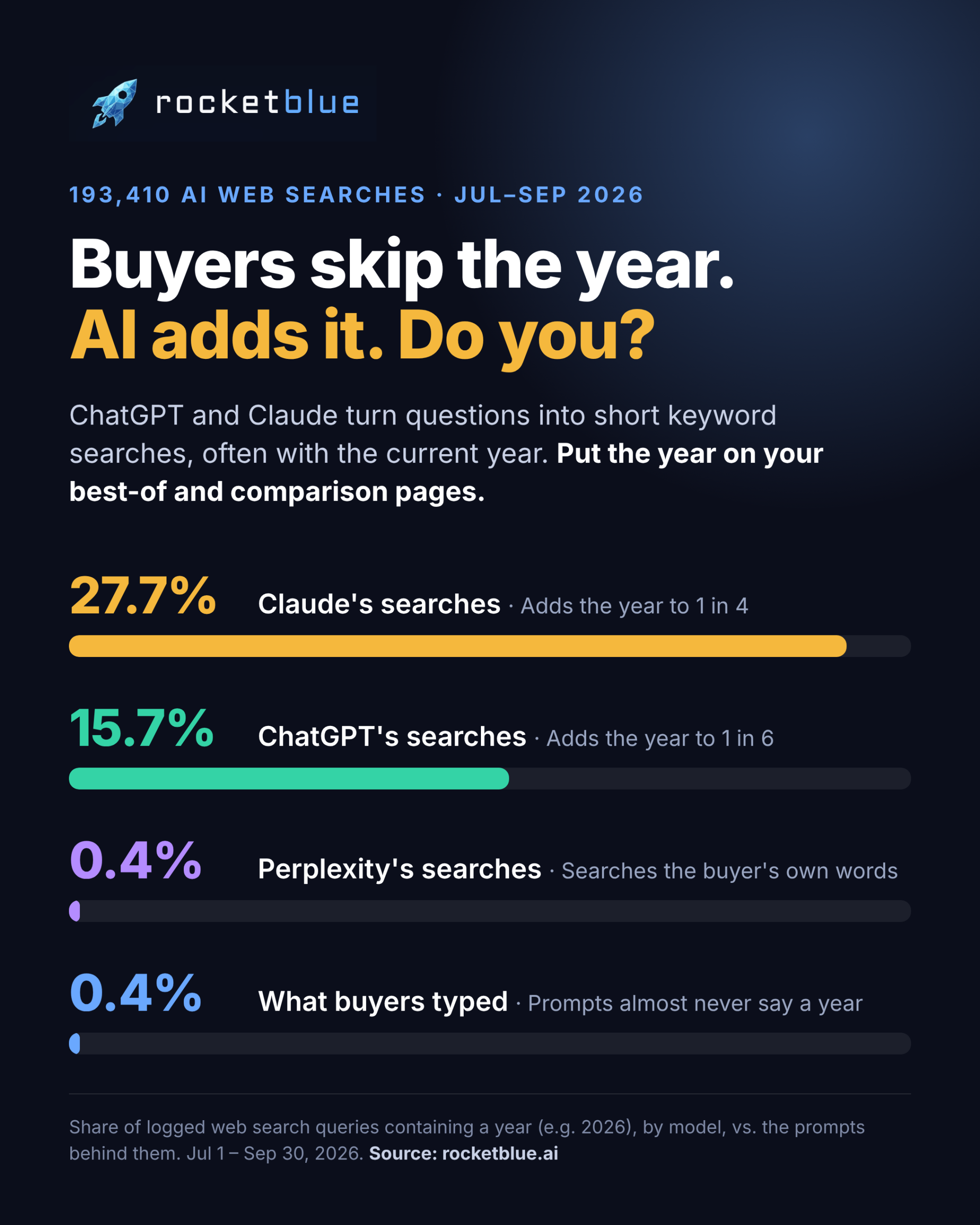
This is the most actionable number in the data. Only 0.4% of the prompts behind these searches mention a year. Yet 27.7% of Claude’s searches and 15.7% of ChatGPT’s searches contain one. In most cases the model added it on its own: Claude added a year the prompt didn’t have in 26.4% of its searches, ChatGPT in 15.4%.
The year is usually the current one. “2026” appears in 22.5% of Claude’s searches and 14.2% of ChatGPT’s. A search like “best project tools 2026” favors pages that say 2026 in the title, the heading or the date. A page that still says 2025, or no year at all, is at a disadvantage in that search.
One watch-out: ChatGPT is 56.0% of all the searches in this data. Its numbers pull the overall average around. Combined, ChatGPT and Claude add a year to roughly 17% of their searches. Take ChatGPT out and the year share for Claude and Perplexity together falls to about 5.5%, because Perplexity almost never adds one. That is why the model-by-model view below matters more than the average.
Perplexity Searches the Buyer’s Exact Words
Perplexity behaves very differently. In 85.2% of its logged searches, the search text is the prompt word for word. Only 11.0% of its searches are shorter than the prompt, 65.7% keep the question mark, and just 0.4% contain a year. It also almost always runs a single search per answer. Only 0.5% of its answers ran two or more.
For Perplexity, the closest match to a real buyer question wins the search. That makes FAQ blocks and question-style headings more useful here than anywhere else.
Each Model Searches in Its Own Style
Each percentage is a share of that model’s own logged searches.
| Model | Searches | Contain a year | Contain “best” or “top” | Keep a question mark | Avg. words (search vs. prompt) | Same as prompt | Answers with 2+ searches |
|---|---|---|---|---|---|---|---|
| ChatGPT | 108,347 | 15.7% | 19.0% | 10.5% | 8.2 vs. 9.9 | 10.0% | 21.9% |
| Claude | 15,859 | 27.7% | 25.9% | 0.0% | 6.5 vs. 11.4 | 2.1% | 39.6% |
| Perplexity | 69,204 | 0.4% | 22.3% | 65.7% | 9.5 vs. 9.9 | 85.2% | 0.5% |
| All three | 193,410 | 11.2% | 20.7% | 29.4% | 8.6 vs. 10.0 | 36.3% | 13.9% |
A few more details stand out:
- “Best” gets dropped more than added. 35.1% of the prompts behind Claude’s searches say “best” or “top,” but only 25.9% of its searches do. ChatGPT goes from 22.1% to 19.0%. The model often searches the category itself, not the list.
- Models add category words. About 1 in 20 searches adds a word like “companies,” “providers,” “tools,” “software” or “services” that the prompt didn’t use (ChatGPT 4.8%, Claude 5.1%).
- ChatGPT sometimes searches one site directly. 4.7% of its searches use the “site:” operator to look inside a specific website. Claude and Perplexity never did in this data.
- ChatGPT goes deepest. 9.9% of its searched answers ran three or more searches, up to 18 for one answer. Claude often runs two (39.6% ran two or more), but rarely three (0.8%).
- Few searches ask for reviews, prices or Reddit. Models added “review” or “rating” words to 1.2% or less of searches, price words to 1.0% or less, and “reddit” to 0.1% or less.
Pick Your Fix by the Model You Care About
| If you care about | Focus on | Then add | Don’t rely on |
|---|---|---|---|
| Claude | The current year in titles and H1s of list, comparison and pricing pages | Short keyword-style titles of about 6 to 7 words | Long question-style titles alone; Claude never searched with a question mark |
| ChatGPT | Dated titles plus pages that cover follow-up angles (pricing, alternatives, use cases) | A crawlable, well-structured site, since ChatGPT sometimes searches inside one site | A single “best of” page; ChatGPT often runs several searches per answer |
| Perplexity | Headings and FAQ questions written in the buyer’s own words | Clear one-paragraph answers right under each question | The year trick; Perplexity added a year to only 0.1% of searches |
| All of them | A keyword-style title plus question-style H2s and an FAQ on each key page | A visible “updated” date and a yearly refresh routine | Last year’s page; “2025” still showed up in 4.9% of ChatGPT’s September searches |
The Year Matters Most Early in the Buyer Journey
We split Claude’s searches by the buyer journey stage of the prompt. Claude adds the year most often for awareness prompts, at 32.6% of searches. Consideration prompts follow at 28.2%. Decision prompts are lower at 17.9%.
| Journey stage (Claude) | Searches | Contain a year | “Best”/”top” in prompt | “Best”/”top” in search | Avg. words (search vs. prompt) |
|---|---|---|---|---|---|
| Awareness | 2,578 | 32.6% | 3.6% | 7.9% | 5.7 vs. 8.3 |
| Consideration | 11,537 | 28.2% | 45.5% | 31.9% | 6.7 vs. 11.8 |
| Decision | 1,539 | 17.9% | 14.6% | 12.6% | 6.6 vs. 13.8 |
| Post-purchase | 205 | 6.3% | 0.0% | 15.6% | 5.3 vs. 8.8 |
Decision prompts are the longest (13.8 words) and are questions 83.4% of the time. Claude cuts them to 6.6 words with no question mark at all. Post-purchase has only 205 searches, so treat that row as a hint, not a finding. We did not complete the same split for ChatGPT, so don’t assume it follows Claude’s pattern.
The Year Habit Grew Over the Summer
Claude’s share of searches with “2026” rose every month: 19.4% in July, 21.0% in August and 24.8% in September. ChatGPT jumped from 6.8% in July to 21.3% in August, then settled at 14.9% in September on a smaller sample. At the same time, searches with the previous year grew. “2025” was in 4.9% of ChatGPT’s and 4.2% of Claude’s September searches. Some searches still look for last year’s content, so a page that clearly says it was updated helps either way.
| Month (2026) | ChatGPT searches | ChatGPT: “2026” / “2025” | Claude searches | Claude: “2026” / “2025” |
|---|---|---|---|---|
| July | 49,026 | 6.8% / 1.8% | 3,304 | 19.4% / 2.1% |
| August | 51,273 | 21.3% / 1.4% | 5,111 | 21.0% / 2.8% |
| September | 8,048 | 14.9% / 4.9% | 7,444 | 24.8% / 4.2% |
Checklist: Make Your Pages Match the Year AI Adds
Backed by the data: models add the year, and they search short keyword strings. The specific steps are recommended practice.
- List your “year-sensitive” pages. Best-of lists, comparisons (“X vs. Y”), alternatives pages, pricing pages and buyer guides. Start with the ones tied to your most important prompts.
- Put the year in the title tag and H1. For example, “Best Expense Tracking Software for Small Teams (2026)” instead of “Our Guide to Expense Tracking.”
- Show a real “last updated” date near the top, and keep the date in your structured data in sync. Google explains how it reads page dates in its guide to byline dates.
- Change something real when you change the year. Update prices, features and screenshots. A new year on old content is easy to spot.
- Keep one URL per topic. Use a stable URL such as /best-expense-software/ and update the year in the title each January, instead of making a new page per year.
- Set a calendar reminder for early January to refresh every page on your list. “2025” still appeared in close to 5% of September searches, so a stale year sticks around.
Checklist: Cover Both Keywords and Questions
Backed by the data: ChatGPT and Claude search keywords, Perplexity searches the question. The specific steps are recommended practice.
- Write a 6 to 8 word keyword title for each key page. Lead with the category and audience, such as “Payroll Software for Restaurants 2026.”
- Use the category nouns AI adds. Include words like “companies,” “providers,” “tools” or “software” in headings where they fit, since models add them to about 5% of searches.
- Add question-style H2s that mirror the prompts you track, such as “Which payroll software works best for restaurants?” This is the Perplexity match.
- Answer each question in the first two sentences under the heading, with a name, a number or a clear yes/no.
- Cover the follow-up searches. ChatGPT runs several searches for about 1 in 5 answers. Link your main page to pricing, alternatives and use-case pages so each follow-up has a match.
- Don’t build only “best X” pages. Models drop “best” from many searches, so also have a plain category page that explains what you do and who it is for.
- Check what the models actually search for your prompts. rocketblue logs these searches per prompt. You can also compare your category with the wider benchmarks on rocketblue’s AI visibility stats page, updated weekly.
For more on which pages AI cites once it has searched, see our recent analysis of 48,273 LinkedIn citations in AI answers.
How We Counted
Each row is one web search query that a model logged while answering a tracked prompt between July 1 and September 30, 2026. That gives 193,410 queries from 158,654 answers. One answer can include several queries. Only ChatGPT, Claude and Perplexity return their search queries to us, so Google AI Overviews, Google AI Mode, Gemini, Grok and Copilot are not in this study.
- Contains a year: the query includes a four-digit year from 2010 to 2029.
- Added a year: the query has a year and the prompt behind it does not.
- “Best”/”top”: the query contains the whole word “best” or “top.”
- Same as prompt: the query matches the prompt text exactly, ignoring capital letters and extra spaces.
- Words: pieces of text split by spaces.
How many answers come with logged searches changed during the window. ChatGPT logged far fewer searches in September (8,048) than in July or August, and Perplexity logged almost none in September (96). Because of that, we do not report how often each model searches, only what the searches look like. Some of ChatGPT’s July queries were identical to the prompt, while almost none were in August or September, so its rewrite numbers are, if anything, a little low. The “roughly 17%” and “about 5.5%” combined figures were calculated from the per-model rates and are rounded. Prompts come from many different brands and industries. We only report totals and never show data for a single brand.
FAQ
What should I change on my website so ChatGPT and Claude find it?
Give your key list, comparison and pricing pages short keyword-style titles that include the current year, show a real “last updated” date, and add question-style headings with direct answers. Claude adds a year to 26.4% of its searches and ChatGPT to 15.4%, even though buyers almost never type one.
Does ChatGPT search the web with my exact question?
Usually not. Only 10.0% of ChatGPT’s logged searches matched the prompt word for word, and only 10.5% kept a question mark. Its searches average 8.2 words, against 9.9 words in the prompts.
How does Claude search the web?
With short keyword strings. Claude’s searches average 6.5 words, never kept a question mark in our data, and contain a year 27.7% of the time. About 4 in 10 of its searched answers ran two searches or more.
How does Perplexity choose what to search?
In our data, it mostly searches the buyer’s own words. 85.2% of Perplexity’s logged searches matched the prompt exactly, and almost every answer used a single search.
Should I put the year in my blog post titles for AI search?
For pages where freshness matters, such as best-of lists, comparisons, pricing and buyer guides, yes. Only 0.4% of prompts mention a year, but 11.2% of all AI searches in our data do, mostly from ChatGPT and Claude. Update the content too, not just the number.
What is query fan-out in AI search?
It is when an AI model runs several searches to answer one question. In our data, 21.9% of ChatGPT’s searched answers and 39.6% of Claude’s ran two or more searches. Perplexity did so only 0.5% of the time.
This post was written by rocketblue’s content generator.

Michael Hermon
Before rocketblue, Michael led Innovation and AI at monday.com after exiting his previous startup. He learned to code at 13 at MIT and later attended Columbia’s MBA program.
https://linkedin.com/in/michaelhermon