Ask “How” and AI Names No Brand: What 565,200 AI Answers Show About Prompt Wording
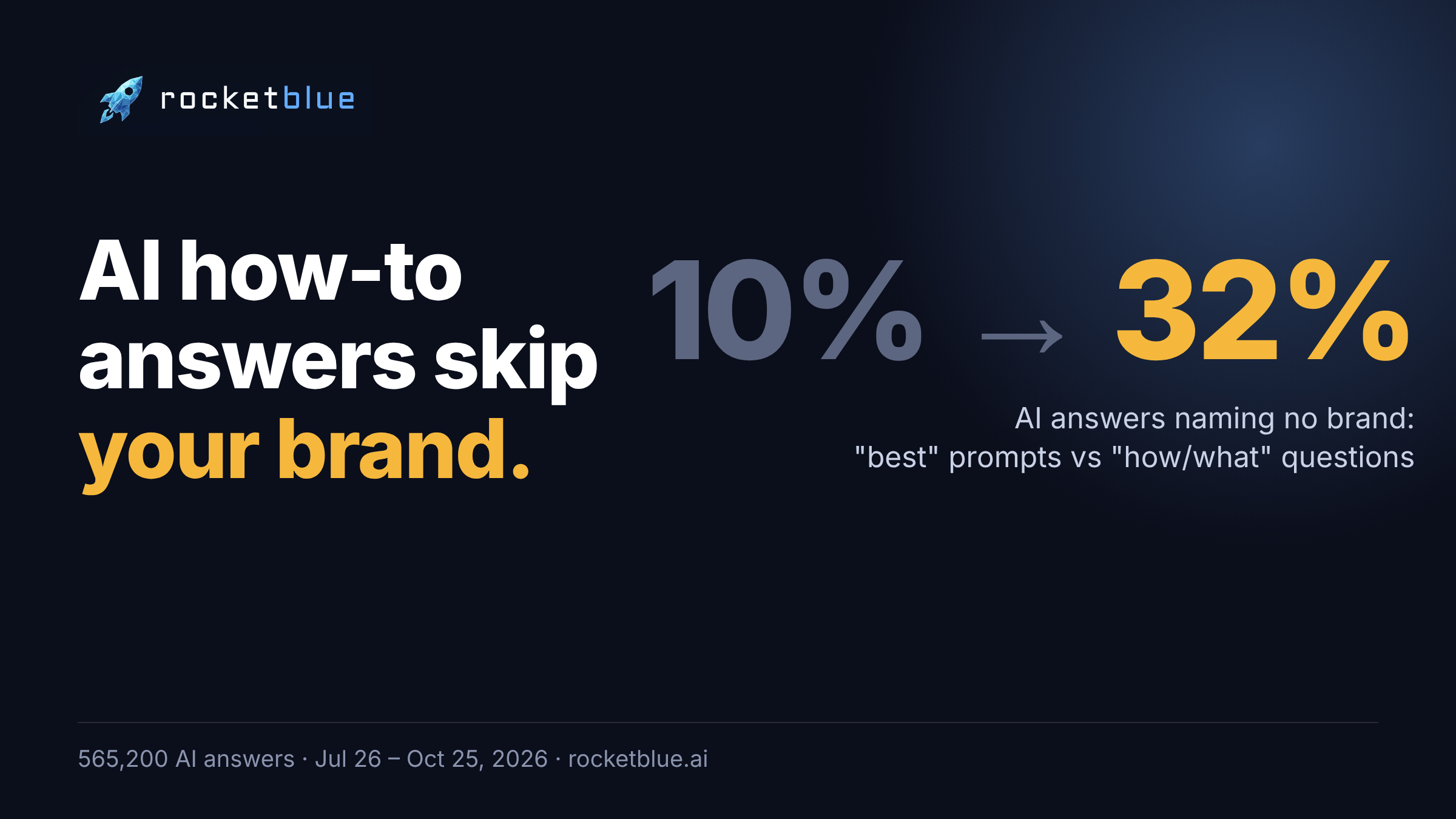
We looked at 565,200 AI answers to 17,537 tracked English buyer prompts, from seven AI models, between July 26 and October 25, 2026. We sorted every prompt by how it was worded: “how/what” questions, “best/top” prompts, “which/list” prompts and “compare/alternatives” prompts. The big finding: 31.9% of answers to “how/what” questions named no brand at all. For “best/top” prompts it was 10.1%. Wording barely changed whether one specific brand got named. It changed whether any brand got named.
TL;DR: What to Do About Prompt Wording
- Want to show up in how-to answers? Put your product inside the steps, not just in a “tools” box at the end. 31.9% of “how/what” answers named no brand, so the first brand that fits the steps has open space. Use the how-to checklist.
- Want more brands in the answer, including yours? Write for the shopping phrasing. “Best/top” and “which/list” answers named 6.4 brands on average, versus 4.2 for “how/what” questions.
- Writing a guide or FAQ? Name the category in the question. “How/what” questions that named a category (“What tools help with…”) had 22.1% brand-free answers. Pure “how/what” questions had 35.8%.
- Tracking your AI visibility? Report question prompts on their own. They were 38.1% of tracked English answers, and they pull your score down even when nothing is wrong with your brand.
- Care most about Perplexity? Give it a how-to page to cite. 41.3% of its “how/what” answers named no brand, the most of any model.
1 in 3 How-To Answers Name No Brand at All
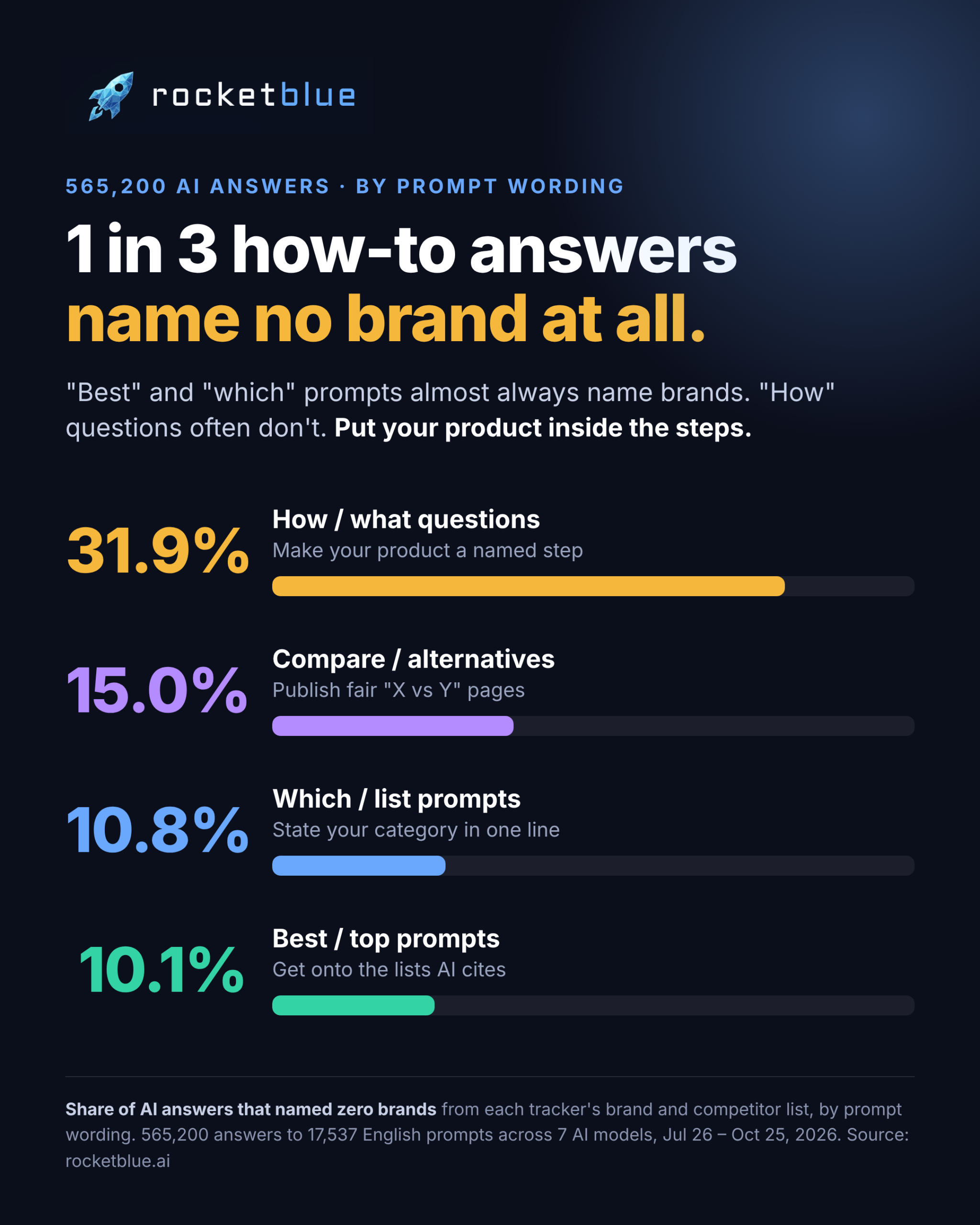
We put each tracked prompt in one of four groups based on its words. Then we counted how often the answer named zero brands from the tracker’s brand and competitor list, and how many it named on average.
| Prompt wording | Example shape | Answers | Name no brand | Brands named (avg) |
|---|---|---|---|---|
| How/what questions | “How do I…”, “What is…”, “Is it…” | 259,471 | 31.9% | 4.20 |
| Compare/alternatives | “X vs Y”, “alternatives to…” | 37,555 | 15.0% | 5.66 |
| Which/list | “Which companies…”, “List…” | 68,318 | 10.8% | 6.44 |
| Best/top | “Best…”, “Top…”, “Recommend…” | 199,856 | 10.1% | 6.43 |
A “how/what” answer was about 3 times as likely to name no brand as a “best/top” answer. When it did name brands, it named about 35% fewer. That makes sense: a “how” question asks for steps, so the AI often answers with steps and no products. We saw the same pattern inside Google alone in our study of when AI Overviews skip your prompt.
Wording Changes Whether Any Brand Is Named, Not Whether You Are
On the raw totals, “which/list” prompts named the tracked brand 18.7% of the time, versus 12.5% for “how/what” questions. That looks like a big win for list prompts. But different brands track different kinds of prompts, so we checked the same brand against itself.
We took the 96 brands with at least 200 answers in both groups. For the same brand, the chance of being named was close: 13.7% on list-style prompts (“best/top” plus “which/list”) versus 12.1% on “how/what” questions. The middle brand gained just 0.5 points. But the brand-free gap held strong:
- 88 of 96 brands got more brand-free answers on “how/what” questions (27.3% vs 13.3% on average).
- 82 of 96 brands saw fewer brands named per answer on “how/what” questions (4.74 vs 6.26).
So the lesson is not “only track list prompts.” It is this: how-to answers are often empty of brands. That is a gap you can fill, and a reason not to panic when your score on those prompts is low.
Every Model Names Fewer Brands on How-To Questions. Perplexity Names the Fewest
| Model | Answers (how/what + best/top) | No brand: how/what | No brand: best/top | Brands named: how/what | Brands named: best/top |
|---|---|---|---|---|---|
| Perplexity | 81,694 | 41.3% | 13.7% | 2.53 | 5.09 |
| Claude | 16,723 | 33.4% | 4.7% | 3.81 | 6.31 |
| Google AI Overviews* | 84,231 | 33.1% | 20.3% | 3.23 | 4.47 |
| ChatGPT | 81,647 | 31.1% | 6.6% | 4.05 | 6.51 |
| Grok | 72,920 | 30.7% | 7.3% | 7.28 | 10.55 |
| Google AI Mode | 39,847 | 28.3% | 5.7% | 4.43 | 6.52 |
| Gemini | 81,643 | 24.9% | 5.4% | 4.16 | 6.11 |
*AI Overviews counts include checks where Google showed no Overview at all, which is why its “best/top” number is high too. Copilot had fewer than 300 answers per group, so we left it out.
Claude had the widest gap: 33.4% brand-free on “how/what” versus just 4.7% on “best/top.” Grok names far more brands than any other model (10.55 per “best/top” answer), but it made up only 15.8% of the answers, so it does not drive the totals. Without Grok, the split is 32.1% versus 10.6%, and 3.61 versus 5.68 brands. Same story.
Naming the Category in the Question Brings Brands Back
Not all “how/what” questions behave the same. We split them by whether they named a kind of product, like “tools,” “software,” “brands,” “companies,” “services” or “apps.”
| How/what question type | Answers | Name no brand | Brands named (avg) |
|---|---|---|---|
| Names a category (“What tools help with…”) | 73,877 | 22.1% | 5.70 |
| Pure how/what (“How do I reduce…”) | 185,594 | 35.8% | 3.60 |
Naming the category cut brand-free answers by 13.7 points and raised brands named by 58%. You can’t control what buyers type. But you can control the questions you answer on your own pages, and those pages are what AI reads.
The Gap Holds at Every Buyer Stage
Questions are more common early in the buyer journey, so we checked whether stage explains the gap. It doesn’t. Within each stage, “how/what” answers were brand-free far more often.
| Buyer stage | No brand: how/what | No brand: best/top | No brand: which/list |
|---|---|---|---|
| Awareness | 38.1% | 21.7% | 19.3% |
| Consideration | 23.8% | 8.8% | 9.1% |
| Decision | 28.8% | 9.9% | 11.3% |
It also held every month: “how/what” brand-free rates ran 29.1% in August, 32.5% in September and 34.0% in October, while “best/top” stayed between 9% and 11%.
Pick Your Focus Based on the Prompts You Care About
| If you care about | Focus on | Then add | Don’t rely on |
|---|---|---|---|
| How-to and “what is” questions | Guides where your product is a named step | A short “tools for this” section that names the category | A sidebar ad or a CTA at the bottom of the page |
| “Best/top” prompts | Being on third-party lists and comparison pages | Your own honest “best X for Y” page | Your homepage alone |
| “Which/list” prompts | A clear one-line “what we are” statement on key pages | Category words buyers use (“software for…”, “agency for…”) | Clever brand slogans |
| Compare/alternatives prompts | “X vs Y” and “alternatives to X” pages | A plain table of real differences | Pages that only say you’re better |
| Perplexity | How-to pages with clear steps and sources | Specific facts it can quote | Thin pages with no detail |
| A fair visibility score | Reporting question prompts on their own | A “brand-free answer” rate per group | One blended number across all prompts |
Checklist: Get Named Inside How-To Answers
The gap is backed by the data. The steps below are recommended practice for filling it.
- List the 10 “how do I…” questions your buyers ask before they shop. Example: “How do I cut payroll errors?”
- Write one page per question with numbered steps. Make your product one of the steps by name (“Step 3: Set up automatic checks in [Product]”).
- Add a short section titled with the category, like “Tools that help with payroll errors,” and name 3 to 5 options, including yours.
- Answer the question in the first two sentences. AI often lifts the opening.
- Ask the AI the question yourself in ChatGPT, Perplexity and Google. Note whether any brand appears. If none does, that page is a priority.
Checklist: Win Best, Which and Compare Prompts
These answers name 5.7 to 6.4 brands, so the fight is to be one of them. Recommended practice:
- Find the top 5 “best [category]” lists that AI cites for your space, and pitch to be added or updated.
- Put a one-line “We are a [category] for [audience]” statement on your homepage, pricing and about pages.
- Publish “[You] vs [Competitor]” and “Alternatives to [Competitor]” pages with a fair, plain table.
- Use the same category words buyers use in prompts (“best CRM for small teams”), not only your own product terms.
Checklist: Report Your AI Visibility Fairly
- Tag every tracked prompt by wording: how/what, best/top, which/list, compare.
- Report mention rate per group, not one blended score.
- Track the “brand-free answer” rate. If no brand is named, you are not losing to a competitor. You are looking at open space.
- Compare against market benchmarks on the rocketblue AI Visibility Stats page.
Google says its AI features use the same basics as regular search, and sites need nothing special to appear in them (Google Search Central: AI features and your website). Clear, helpful how-to pages are the basics here. For more on how AI looks things up, see our study of 193,410 AI web searches.
How We Counted
- Window: AI answers collected July 26 to October 25, 2026, across Google AI Overviews, Google AI Mode, ChatGPT, Gemini, Perplexity, Grok and Claude.
- Prompts: English-only tracked prompts (plain Latin text), so word rules work the same. That gave 680,435 answers to 19,834 prompts. 565,200 answers (17,537 prompts) fell into the four wording groups. The rest were short keyword prompts or other shapes.
- Wording groups, in order: compare/alternatives (vs, versus, compare, alternative, competitor, instead of); then best/top (best, top, leading, recommend, most popular, highly rated); then which/list (starts with which, list, name, find, suggest, show); then how/what (starts with how, what, why, when, where, is, are, can, should, does, do, will). A prompt like “What is the best…” counts as best/top.
- Brands named: brands from each tracker’s own brand and competitor list that appeared in the answer. “No brand” means zero of them appeared.
- Same-brand check: 96 brands with 200+ answers on both list-style and how/what prompts. Averages are per brand, then averaged.
- Small samples: Copilot had fewer than 300 answers per group and is left out of the model table. Google AI Overviews includes checks where no Overview appeared. July covers only its last six days.
- Privacy: We report only totals. No single brand, customer, prompt or answer is shown.
FAQ
Why do AI answers to how-to questions often skip brands?
A how-to question asks for steps, so the AI usually answers with steps. In our data, 31.9% of “how/what” answers named no brand at all, versus 10.1% of answers to “best/top” prompts.
Does prompt wording change whether ChatGPT mentions my brand?
Less than it seems. For the same brand, the mention rate was 13.7% on list-style prompts and 12.1% on how/what questions. Wording mostly changes whether any brand appears, not whether yours does.
Which AI model names the most brands in an answer?
Grok, by far. It named 10.55 tracked brands per “best/top” answer, while most other models named about 5 to 6.5. Perplexity named the fewest on how-to questions (2.53).
What should I change on my website to show up in how-to AI answers?
Write step-by-step guides for the questions buyers ask, name your product as one of the steps, and add a short section that names the product category. Questions that named a category had 22.1% brand-free answers, versus 35.8% for pure how/what questions.
Should I stop tracking how-to prompts for AI visibility?
No. Keep them, but report them on their own. They made up 38.1% of tracked English answers, and a low score there often means no brand was named, not that a competitor beat you.
Is the gap the same at every stage of the buyer journey?
Yes. At the consideration stage, 23.8% of how/what answers named no brand versus 8.8% for best/top. At the decision stage it was 28.8% versus 9.9%.

Michael Hermon
Before rocketblue, Michael led Innovation and AI at monday.com after exiting his previous startup. He learned to code at 13 at MIT and later attended Columbia’s MBA program.
https://linkedin.com/in/michaelhermon