
Fresh Lists, Old News: What 9.5 Million AI Citations Show About Dates in URLs
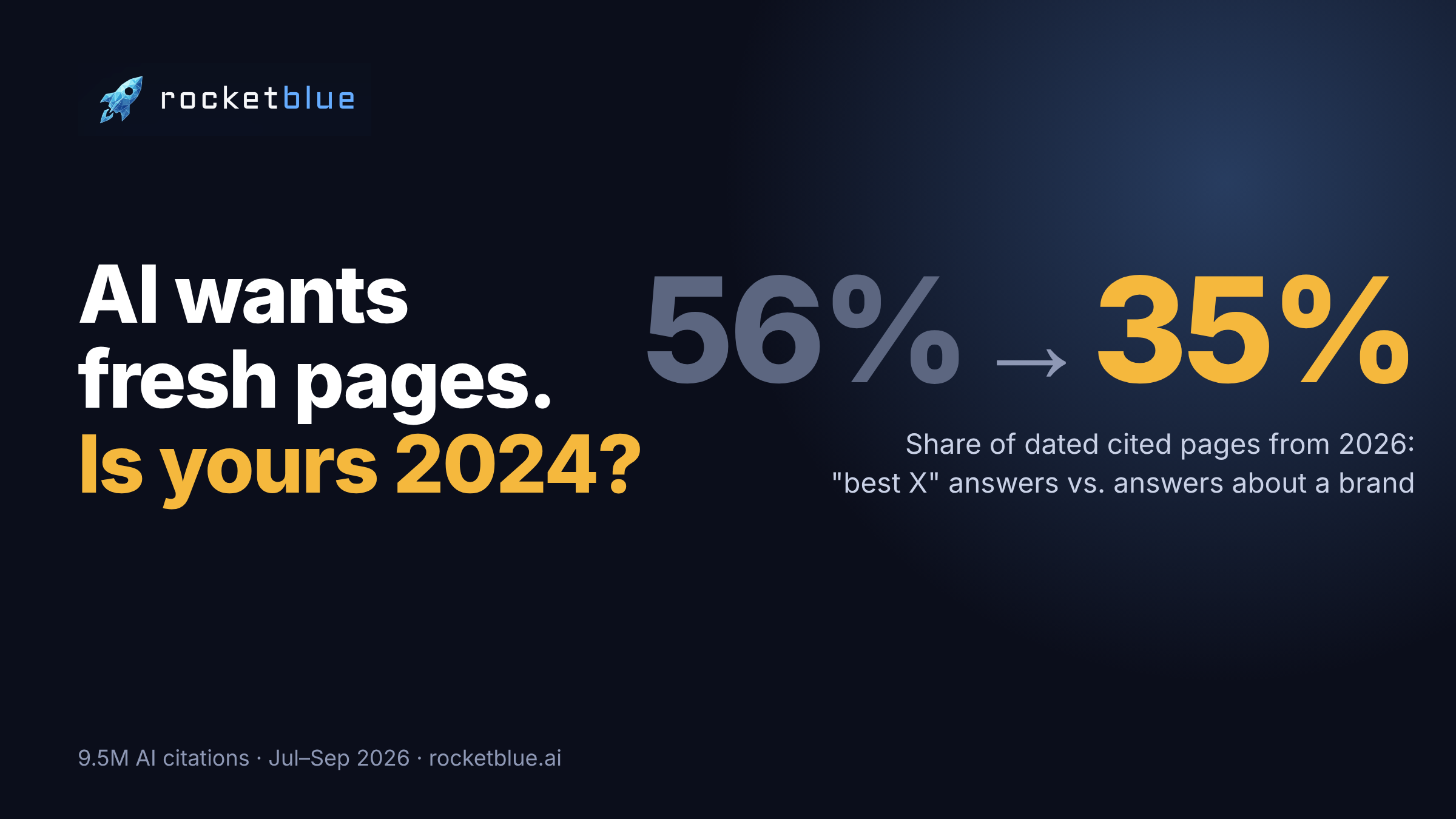
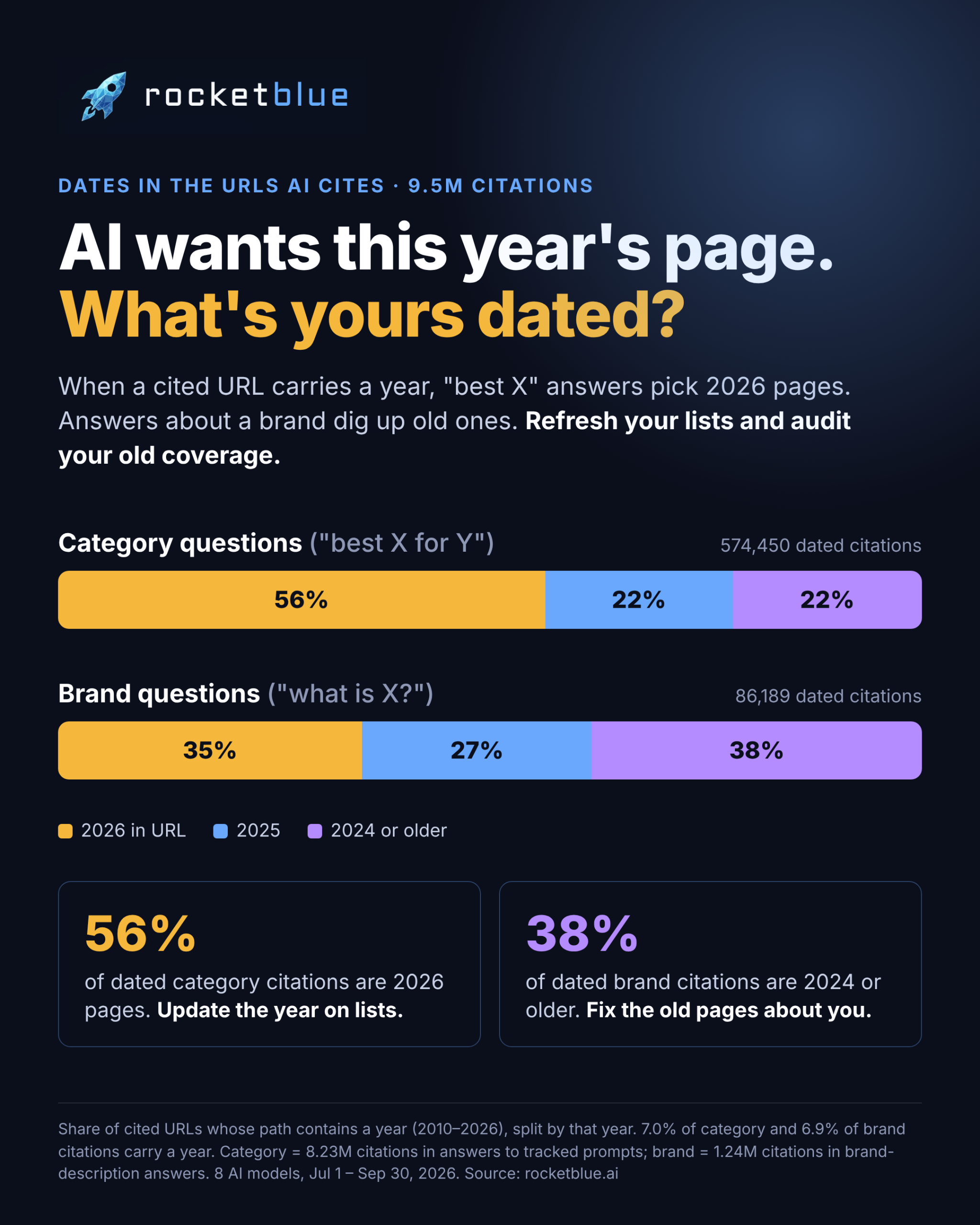
We looked at 9,473,957 citations from eight AI models between July 1 and September 30, 2026, and checked which cited URLs have a year in them, like /best-crm-tools-2026/ or /2024/05/. Only about 7% do. But when they do, the year tells a clear story: answers to “best X” questions mostly cite 2026 pages (56%), while answers that describe a brand lean on older pages, with 38% from 2024 or earlier.
So the same AI tool acts like two different readers. For shopping-style questions it wants this year’s list. For “what is this company?” questions it digs through the archive. Here is what that means for your content plan.
TL;DR: What to Do With Dates on Your Pages
- Want to show up in “best X” answers? Keep your lists and comparisons current and say the year. 56% of dated citations in these answers are 2026 pages, and URLs with 2026 in the slug were cited 3.6 times each on average in September vs 2.5 for older-year slugs.
- Want AI to describe your brand correctly? Audit the old pages about you. In brand answers, 38% of dated citations are from 2024 or earlier, and 39% are news-style archive URLs.
- Have a 2025 page that still ranks? Refresh it now. 2025 pages still make up 22% of dated category citations, but 2026 pages already outnumber them more than 2 to 1.
- Care most about Claude or ChatGPT? They favor fresh pages the most: 78% (Claude) and 65% (ChatGPT) of their dated category citations are 2026 pages. Perplexity is the most archive-friendly at 43%.
Only 7% of AI Citations Have a Year in the URL
Most pages AI cites have no date in the address at all. Across 8,229,929 citations in answers to tracked category questions (prompts like “best project management tool for agencies”), 574,450, or 7.0%, pointed to a URL with a year between 2010 and 2026 in the path. In brand-description answers, the share was almost the same: 6.9% of 1,244,028 citations.
That small slice is still useful. A year in a URL is one of the few freshness signals you can read straight from the address, and it shows up most on the kinds of pages marketers create on purpose: “best of” lists, comparisons, yearly guides and news posts.
“Best X” Answers Pick This Year’s Pages 56% of the Time
When a cited URL in a category answer had a year, it was 2026 in 56.4% of cases, 2025 in 21.7%, and 2024 or earlier in 21.9%. We’re only nine months into the year, and 2026 pages already outnumber 2025 pages more than 2 to 1.
The fresh pages are mostly lists. In September, 59.6% of cited URLs with “2026” in the slug also had words like best, top, alternatives, vs, compare or review. For older-year slugs, that share was only 34.3%. Each 2026 slug URL was also cited more often: 3.6 times on average in September, compared with 2.5 times for older-year slug URLs. This matches what we saw in our listicles vs reviews study: lists get you named, and fresh lists get picked first.
Grok Makes Up 35% of Citations, and the Result Holds Without It
Grok produced 34.9% of all category citations in this window, so we checked the numbers without it. Without Grok, 5.2% of category citations carry a year, and 57.7% of those are 2026 pages (vs 56.4% with Grok). For brand answers, Grok is 35.8% of citations; without it, 35.4% of dated citations are 2026 pages and 40.1% are 2024 or older. Grok doesn’t change the story. If anything, removing it makes the gap between category and brand answers a bit wider.
Claude and ChatGPT Prefer Fresh Pages Most, Perplexity the Least
Every model picks 2026 pages most often in category answers, but how strongly differs a lot. Claude is the freshest: 78% of its dated category citations are 2026 pages, and only 9% are 2024 or older. Perplexity sits at the other end: 43% are 2026 pages and 34% are 2024 or older, likely because it cites more news archives (33% of its dated URLs have a /year/month/ path).
| Model | Category citations | % with a year in URL | Dated category: 2026 | Dated category: 2024 or older | Dated brand: 2026 | Dated brand: 2024 or older |
|---|---|---|---|---|---|---|
| Grok | 2,873,684 | 10.3% | 55% | 21% | 35% | 36% |
| ChatGPT | 1,608,028 | 6.8% | 65% | 20% | 37% | 37% |
| Perplexity | 1,326,556 | 4.3% | 43% | 34% | 27% | 49% |
| Google AI Overviews | 1,109,481 | 3.6% | 50% | 27% | 39% | 38% |
| Google AI Mode | 614,220 | 4.9% | 59% | 22% | 39% | 37% |
| Gemini | 597,082 | 5.1% | 61% | 18% | 37% | 39% |
| Claude | 94,696 | 10.7% | 78% | 9% | 34% | 48% |
| Copilot* | 6,182 | 26.6% | 98% | 0% | 91%* | 2%* |
| All models | 8,229,929 | 7.0% | 56% | 22% | 35% | 38% |
Brand Answers Dig Up Old News: 38% of Dated Citations Are From 2024 or Earlier
When AI describes a brand, the picture flips. Only 35.2% of dated citations are 2026 pages. 26.6% are from 2025, and 38.2% are from 2024 or earlier. The type of page changes too: 39.1% of dated brand citations use a news-style /year/month/ archive path, compared with 23.9% in category answers. Every model shows this. Even Claude, the freshest model for category questions, pulls 48% of its dated brand citations from 2024 or earlier.
That makes sense. To describe a company, a model looks for anything about it: funding news, launch posts, old reviews, a press mention from three years ago. If those pages describe an old product, old pricing or an old positioning, that is what ends up in the answer. We saw a related pattern in our study of when AI uses your own website.
The Fresh-Page Share Held Steady From July to September
Month by month, the share of dated category citations that point to 2026 pages was 54.9% in July, 57.4% in August and 55.9% in September. Without Grok (which had almost no category data in July), it rose from 54.9% to 58.6% to 59.4%. This is not a one-month spike. It is how AI search has worked all quarter, and it will reset in January when “2027” pages start to appear.
Which Pages to Refresh First
| If you care about | Focus on | Then add | Don’t rely on |
|---|---|---|---|
| Being named in “best X” answers | Your own “best X” and comparison pages, plus third-party lists you appear in | The current year in the title, a visible “updated” date, new data | A 2024 or 2025 list that still ranks in Google |
| How AI describes your brand | Old news, launch posts and reviews about you | Updates or editor’s notes on pages you control; fresh coverage that replaces old stories | Your homepage alone setting the record straight |
| Claude and ChatGPT | Current, dated list pages | Yearly refresh on a set schedule | Evergreen pages with no date at all |
| Perplexity and Google AI Overviews | Both fresh lists and your news archive | Clean, accurate older press pages | Removing old posts without redirects |
Checklist: Refresh Your “Best X” Pages for 2026
Backed by the data: AI favors 2026 list pages in category answers. Recommended practice: the specific steps below.
- List every “best”, “top”, “alternatives” and “vs” page you own. Sort by traffic.
- For any page with 2024 or 2025 in the title, review the picks, prices and screenshots, then update the year. Example: “Best HR Software for Small Teams (2026)”.
- If the URL has an old year, move it to a year-free slug (like
/best-hr-software/) with a 301 redirect, so you don’t have to change the URL again next year. Keep the year in the title instead. - Add a visible “Last updated” date and matching
dateModifiedin your structured data, as described in Google’s guide to publication dates and on schema.org. Only change the date when the content really changes. - Ask the publishers of third-party lists you appear in whether a 2026 update is planned, and send them fresh facts about your product.
- Put a reminder in your calendar for early January to repeat this for 2027.
Checklist: Clean Up the Old Pages That Describe Your Brand
Backed by the data: brand answers lean on older and news-style pages. Recommended practice: the steps below.
- Ask ChatGPT, Perplexity and Google AI Mode “What is [your brand]?” and write down every source they cite.
- Mark any source from 2024 or earlier that gets your product, pricing, team or positioning wrong.
- On pages you control (old blog posts, launch posts, press pages), add a short “Update, 2026:” note at the top with the current facts, or redirect the page to its current version.
- For third-party news stories you can’t edit, create new coverage: a 2026 announcement, a customer story or an updated “About” page that tells the current story.
- Update review profiles and directory listings with today’s product names and pricing.
- Repeat the check every quarter. You can compare against the market-wide numbers on our AI Visibility Stats page.
How We Counted
- Window: July 1 to September 30, 2026 (the last three full months).
- Category questions: 8,229,929 citations in answers to tracked prompts across rocketblue’s dataset. Brand questions: 1,244,028 citations in answers where a model describes a brand. Total: 9,473,957.
- Models: Grok, ChatGPT, Perplexity, Google AI Overviews, Google AI Mode, Gemini, Claude and Copilot.
- “Dated” URL: the URL path (before any “?”) contains a standalone four-digit year from 2010 to 2026. If more than one year appears, we used the first one.
- Archive path: the path has a /year/month/ pattern, as many news sites and blogs use. Slug year: the year is attached to words, like “best-crm-2026”.
- List-style words: best, top, alternatives, vs, compare or review in the path. This was checked for September only.
- What it doesn’t show: a year in the URL is only a proxy for freshness. About 93% of cited pages have no year in the URL, and we didn’t read publish dates inside pages. Grok had very little category data in July, so we report monthly numbers with and without it. Copilot’s samples are small.
- Privacy: we report totals only. No single brand’s or customer’s data is shown.
FAQ
Does AI search prefer newer content?
For “best X” style questions, yes. When a cited URL had a year in it, 56% were 2026 pages in our July to September 2026 data. For questions about a specific brand, AI is much more willing to cite old pages: only 35% were 2026 pages and 38% were from 2024 or earlier.
Should I put the year in my blog post title or URL?
Put it in the title of pages that people expect to be current, like “best of” lists and comparisons, and update it when you refresh the content. Keep the URL year-free if you can, so you don’t need a redirect every January.
Which AI model cares most about fresh content?
In our data, Claude: 78% of its dated citations in category answers were 2026 pages. ChatGPT came next at 65%. Perplexity was the lowest at 43%, and it cites more news archive pages.
Why does ChatGPT describe my company with old information?
When AI describes a brand, it often pulls from older news stories, launch posts and reviews. In our data, 37% of ChatGPT’s dated citations in brand answers were from 2024 or earlier. If those pages are out of date, the answer will be too.
Will changing the date on a page without updating it help?
We don’t recommend it. Our data shows AI picks current-year pages, not that it rewards fake updates. Google also asks site owners to show dates that match real changes. Update the content first, then the date.
What should I change this quarter to get cited more by AI?
Refresh your “best X” and comparison pages for 2026, ask third-party list owners to update theirs, and audit the old news and blog pages that AI uses to describe your brand. Then check again in January, when 2027 pages start to compete.

Michael Hermon
Before rocketblue, Michael led Innovation and AI at monday.com after exiting his previous startup. He learned to code at 13 at MIT and later attended Columbia’s MBA program.
https://linkedin.com/in/michaelhermon