No Sources, No Story: What 135,115 AI Answers Show About When AI Can’t Describe Your Brand
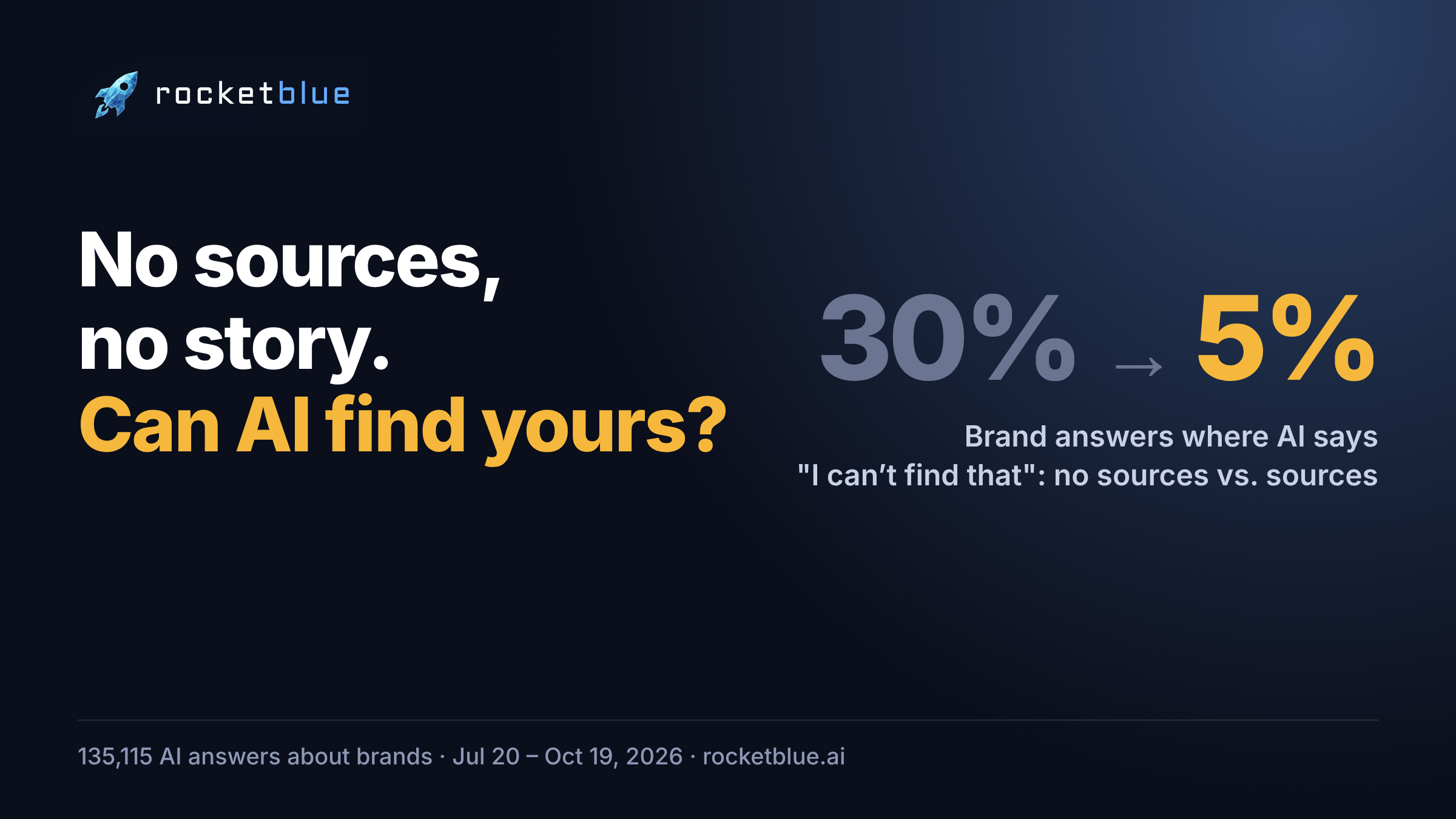
We looked at 135,115 AI answers to questions about specific brands, from seven AI models, between July 20 and October 19, 2026. These are questions like “Is [brand] good for small teams?” or “How does [brand] handle customer support?” In 8.5% of them, the AI said some version of “I can’t find information on that.” The big split was sources. When the answer cited no sources, the AI came up empty 29.9% of the time. When it cited at least one, that fell to 5.4%.
TL;DR: What to Do So AI Can Describe Your Brand
- Want AI to stop saying “I can’t find that” about you? Give it pages to cite. Answers with no sources came up empty 29.9% of the time, vs 5.4% for answers with sources. Use the fact page checklist.
- Worried this is just “small brands are unknown”? It isn’t only that. For the same brand on the same model, uncited answers came up empty 19.9% of the time vs 6.7% for cited ones.
- Want a better description, not just any description? Sources help there too. 70.8% of cited answers got our top quality grades, vs 42.6% of uncited ones.
- Going after Claude? It is the weak spot. 56.1% of its brand answers cited nothing, and 36.7% of all its brand answers came up empty.
- Going after Perplexity? Sources alone aren’t enough. It still came up empty 14.0% of the time with sources, so publish pages that answer the exact question. See the exact-answer checklist.
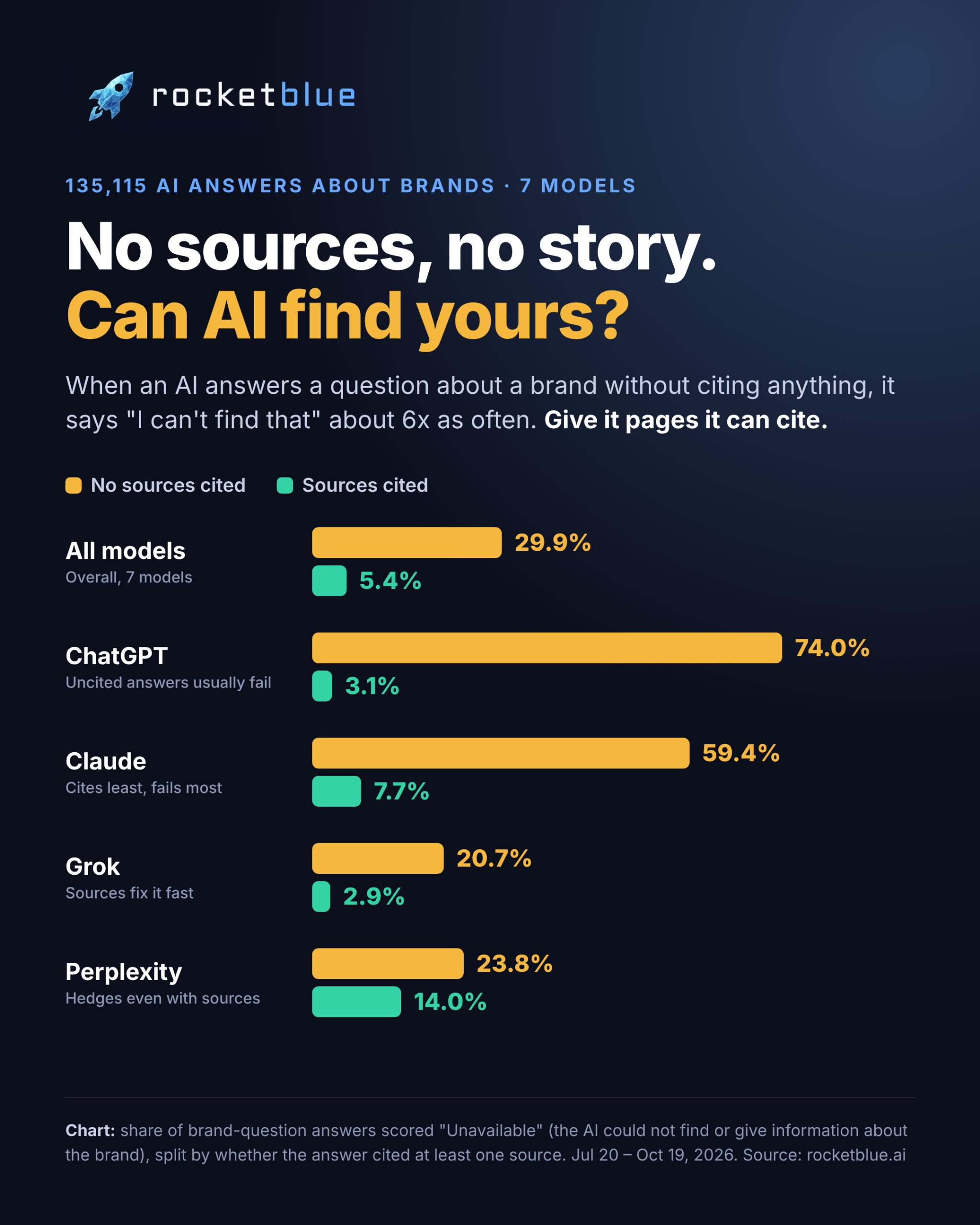
Answers Without Sources Come Up Empty About 6x as Often
We track two kinds of questions. Category questions ask for the best option, like “What is the best CRM for a small agency?” Brand questions ask the AI to describe one brand. This study is only about brand questions. They are the questions a buyer asks once you are already on their shortlist.
Each answer gets a quality grade. One of those grades is “Unavailable.” It means the AI did not give any real information about the brand. It said it could not find the business, could not confirm the detail, or only said it would “check” without checking. In this post we call that a “can’t find” answer.
- All brand answers: 8.5% were “can’t find” answers (11,549 of 135,115).
- Answers that cited no sources: 29.9% came up empty (17,594 answers).
- Answers that cited at least one source: 5.4% came up empty (117,521 answers).
That is about 5.6 times as often. Only 13.0% of brand answers cited nothing, but they produced almost half (45%) of all the “can’t find” answers.
The Gap Holds for the Same Brand on the Same Model
A fair question: maybe brands with little online presence get both fewer sources and more “can’t find” answers. That would make sources a symptom, not a fix. So we compared each brand with itself. We kept every brand and model pair that had at least 10 cited and 10 uncited answers. That gave us 388 pairs covering 157 brands and 56,776 answers.
- Same brand, same model, no sources: 19.9% came up empty.
- Same brand, same model, with sources: 6.7% came up empty.
The gap shrinks from about 6x to about 3x, but it does not go away. Even a brand the AI can find gets a “can’t find” answer when the AI skips its sources for a given question. This is still a correlation, not a controlled test. But it points the same way as everything else in the data.
Sources Also Make the Description Better
Sources don’t just stop empty answers. They change how well the AI describes the brand. We grouped the top two quality grades (Great and Exceptional) together.
- Cited answers: 70.8% got a top grade.
- Uncited answers: 42.6% got a top grade.
More sources is not always better, though. Answers with 1 to 5 citations had the lowest “can’t find” rates (5.7% for 1 to 2, 3.4% for 3 to 5). Answers with 6 to 10 citations rose to 8.3%, mostly because Perplexity often cites many pages and still hedges (more on that below). What matters is having a source that answers the question.
Claude Skips Sources Most and Comes Up Empty Most
No single model dominates this dataset by volume. ChatGPT, Gemini and Perplexity each have about 25,000 answers. Claude is the smallest major model at 5,997. But Claude is the outlier on behavior. It cited no sources in 56.1% of its brand answers, and 36.7% of all its brand answers came up empty. That is 2,201 of the 11,549 “can’t find” answers.
So we checked the result without Claude. The gap stays big: 22.9% “can’t find” without sources vs 5.3% with sources, across 129,118 answers. Claude makes the gap larger, but it doesn’t create it.
| Model | Brand answers | Cited no sources | “Can’t find” overall | “Can’t find” without sources | “Can’t find” with sources |
|---|---|---|---|---|---|
| Perplexity | 25,116 | 11.9% | 15.1% | 23.8% | 14.0% |
| Gemini | 25,089 | 11.7% | 5.5% | 16.7% | 4.0% |
| ChatGPT | 25,087 | 3.8% | 5.8% | 74.0% | 3.1% |
| Grok | 21,197 | 25.7% | 7.5% | 20.7% | 2.9% |
| Google AI Overviews | 20,855 | 5.5% | 4.7% | 15.4% | 4.0% |
| Google AI Mode | 11,580 | 6.4% | 1.4% | 6.6% | 1.0% |
| Claude | 5,997 | 56.1% | 36.7% | 59.4% | 7.7% |
| All models | 135,115 | 13.0% | 8.5% | 29.9% | 5.4% |
A few things stand out:
- ChatGPT almost always cites (only 3.8% of its brand answers cite nothing). But when it doesn’t, 74.0% of those answers are empty. Some only say they will “check current information” and stop there.
- Google AI Mode rarely comes up empty (1.4%), with or without sources.
- Perplexity is the exception. It came up empty 14.0% of the time even with sources. In the answers we read, it often found pages about the brand but none that answered the exact question, so it said it “can’t confirm” the detail.
When Models Started Citing More, Empty Answers Dropped
We also looked month by month. Two models changed how often they cited sources during the window, and their “can’t find” rates moved with them.
| Model and month | Answers | Cited no sources | “Can’t find” rate |
|---|---|---|---|
| Claude, July (from Jul 20) | 964 | 74.5% | 48.8% |
| Claude, August | 2,294 | 67.0% | 42.9% |
| Claude, September | 1,705 | 44.4% | 27.9% |
| Claude, October (to Oct 19) | 1,034 | 33.9% | 26.2% |
| Grok, July (from Jul 20) | 2,671 | 98.7% | 19.4% |
| Grok, August | 6,718 | 30.6% | 7.8% |
| Grok, September | 7,187 | 5.1% | 4.1% |
| Grok, October (to Oct 19) | 4,621 | 8.6% | 5.4% |
As Claude’s share of uncited answers fell from 74.5% to 33.9%, its “can’t find” rate fell from 48.8% to 26.2%. Grok went from citing almost nothing to citing almost always, and its rate fell from 19.4% to about 4 to 5%. Models are moving toward search. That makes the pages they can find matter more every month.
What to Focus On, by Goal
| If you care about | Focus on | Then add | Don’t rely on |
|---|---|---|---|
| Not being a “can’t find” answer | A crawlable fact page per common buyer question | Third-party profiles (reviews, directories, press) | The model “just knowing” your brand |
| Claude | Clear, quotable facts on pages that rank in normal search | Coverage on well-known third-party sites | Claude searching on its own (it cited nothing in 56.1% of answers) |
| Perplexity | Pages that answer the exact question in the first lines | Dated, specific facts (prices, policies, certifications) | A general “About us” page |
| ChatGPT | Letting OpenAI’s search crawler reach your site | Up-to-date facts it can confirm | Old training data |
| A better description, not just any | Sources that state your strengths plainly | Customer proof with numbers | Marketing slogans with no facts |
Checklist: Give AI a Page to Cite for Every Brand Question
Backed by the data: answers that cite a source come up empty far less often (5.4% vs 29.9%), even for the same brand on the same model (6.7% vs 19.9%). Recommended practice: the steps below are how we would act on that.
- List the questions buyers ask about you. Think pricing, support, security, integrations, who you’re for, and how you compare. Ten to twenty questions is a good start.
- Ask each question to ChatGPT, Claude, Perplexity and Gemini. Note every answer that says “I can’t find,” “I can’t confirm” or “no public information.”
- Give each gap one page or one clear section. Example: “Does [brand] offer phone support?” gets a support page that says “Yes, phone support is available Monday to Friday, 8am to 6pm CET.”
- Put the answer in the first two sentences. Follow Google’s advice on helpful, people-first content: say it plainly, then add detail.
- Add Organization structured data with your name, logo, address and official profiles. See Google’s Organization markup guide and schema.org/Organization.
- Check that AI crawlers can reach those pages. For ChatGPT, make sure your robots.txt allows OpenAI’s search crawler (see OpenAI’s crawler docs).
- Re-ask the same questions in 4 to 6 weeks. Track how many “can’t find” answers are left.
Checklist: Write Exact Answers So Perplexity Can Confirm Them
Backed by the data: Perplexity came up empty 14.0% of the time even when it cited sources, the highest of any model. Recommended practice: the steps below.
- Use the buyer’s words in your headings. If people ask “Is [brand] GDPR compliant?”, use a heading like “GDPR compliance at [brand].”
- State specific facts, not claims. “ISO 27001 certified since 2023” can be confirmed. “Enterprise-grade security” cannot.
- Date anything that changes. Add “Updated October 2026” to pricing, policy and feature pages.
- Publish your prices or a clear price range. “Contact us” leaves the AI nothing to confirm.
- Back up key facts off-site. Make sure review sites, directories and partner pages say the same thing. Brand answers lean on those too (see our study on listicles and reviews in AI citations).
Your Own Website Is the First Source to Fix
Last week we found that AI cites a brand’s own website in 79% of answers about that brand (read the study). Put that next to this study and the lesson is simple. When AI is asked about you, it looks for your pages first. If those pages don’t answer the question, you risk a “can’t find” answer. You can check weekly benchmarks for how AI models pick sources on our AI Visibility Stats page.
How We Counted
- Window: July 20 to October 19, 2026.
- Data: 135,115 graded answers to brand questions for 426 brands tracked in rocketblue, across ChatGPT, Gemini, Perplexity, Grok, Claude, Google AI Overviews, Google AI Mode and a small Copilot sample (194 answers). These answers carried 1,405,424 citations.
- “Can’t find” answer: an answer graded “Unavailable,” meaning it gave no real information about the brand (could not find it, could not confirm the detail, or declined).
- Excluded: Google AI Overviews searches where no overview was shown at all, and a handful of malformed grades.
- Cited vs uncited: an answer counts as “cited” if we captured at least one source link in it.
- Same-brand check: brand and model pairs with at least 10 cited and 10 uncited answers (388 pairs, 157 brands, 56,776 answers), pooled.
- Caveats: this is observational data, not a controlled test. Source capture can vary by model and month, so treat the monthly view as direction. We only publish totals across all brands. We don’t name brands or quote their prompts.
FAQ
Why does ChatGPT say it can’t find information about my company?
Usually because it didn’t find a page that answers the question. In our data, ChatGPT brand answers with no sources came up empty 74.0% of the time, vs 3.1% with sources. Make sure your key facts are on crawlable pages and that OpenAI’s search crawler is allowed.
How often does AI fail to describe a brand?
In 135,115 brand answers from July to October 2026, 8.5% gave no real information. The rate ran from 1.4% on Google AI Mode to 36.7% on Claude.
Do sources make AI answers about my brand more accurate?
They make them fuller and better graded. 70.8% of cited brand answers got our top quality grades, vs 42.6% of uncited ones. Cited answers also came up empty far less often (5.4% vs 29.9%).
Which AI model knows the least about brands?
In our data, Claude. It cited no sources in 56.1% of its brand answers, and 36.7% of its brand answers came up empty. Its rate improved during the window as it cited more often, from 48.8% in late July to 26.2% in October.
Why does Perplexity say it can’t confirm details about my brand?
Perplexity often finds pages about a brand that don’t answer the exact question. It came up empty 14.0% of the time even with sources. Write pages that answer specific questions in plain words, with dates and numbers.
What should I change so AI can describe my brand?
Ask the AI models your buyers’ top questions about you. For every “can’t find” answer, publish one clear page or section that answers it in the first two sentences. Add Organization structured data, keep third-party profiles consistent, and check again in 4 to 6 weeks.

Michael Hermon
Before rocketblue, Michael led Innovation and AI at monday.com after exiting his previous startup. He learned to code at 13 at MIT and later attended Columbia’s MBA program.
https://linkedin.com/in/michaelhermon