
Named by One AI, Missed by Four: What 665,045 AI Answers Show About Model Agreement
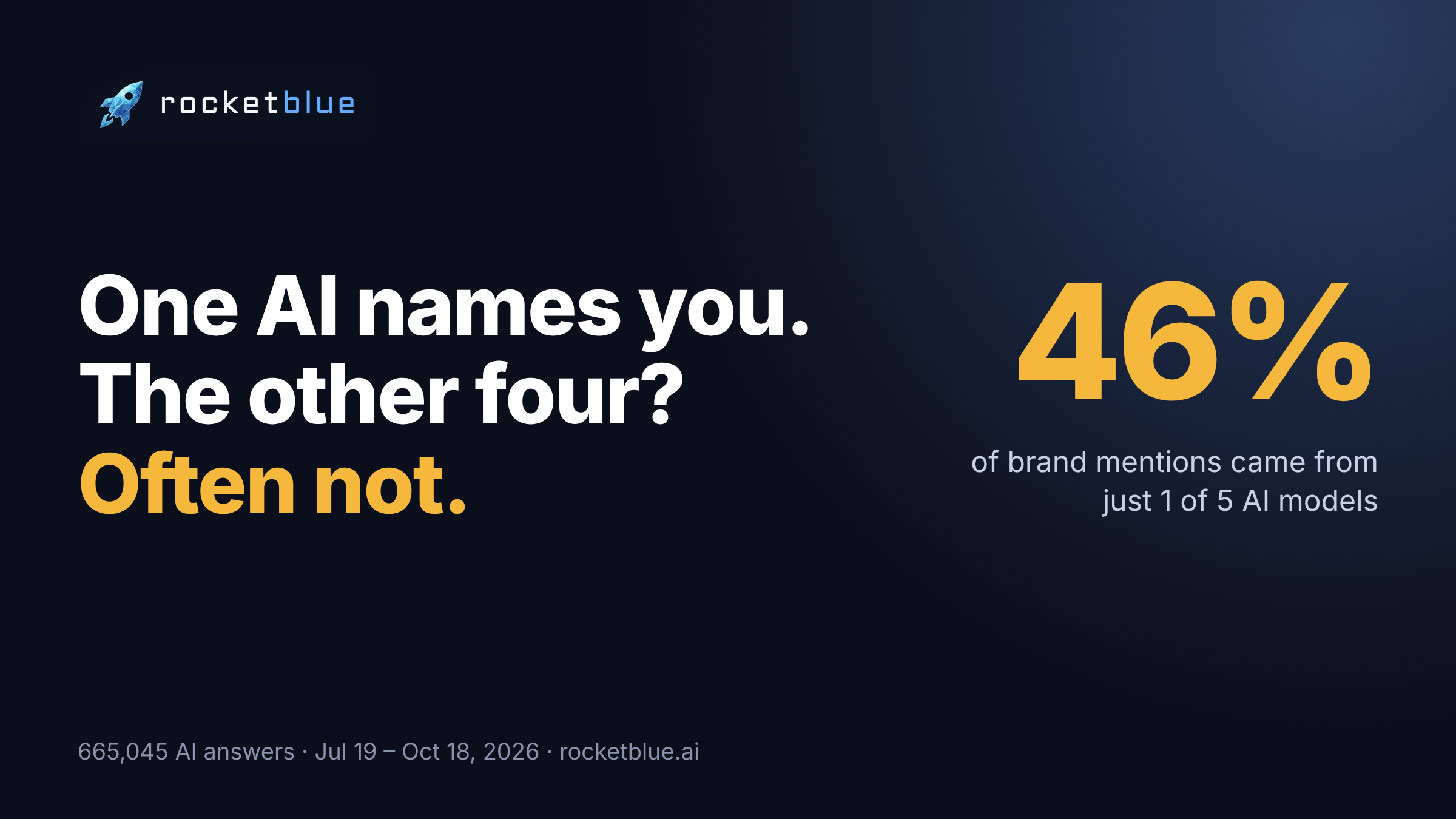
We looked at 665,045 AI answers saved between July 19 and October 18, 2026. Each tracked question was sent to five AI models in the same run: ChatGPT, Gemini, Google AI Overviews, Grok and Perplexity. In 42,408 of those question runs, at least one model named the brand being tracked. The big finding: in 45.7% of them, only one of the five models named it. All five agreed just 8.1% of the time. One good answer in one tool tells you very little about the others.
TL;DR: What to Do About Cross-Model Visibility
- Want a true picture of your AI visibility? Track every major model, not just ChatGPT. When ChatGPT names a brand, Perplexity names it in the same run only 40.6% of the time. Use the checklist below.
- Want to be the first brand AI names? Aim for agreement across models. Brands named by all five models were named first 69.1% of the time. Brands named by only one model were named first 28.0% of the time.
- Showing up in only one tool? Treat it as a start, not a win. Grok is the most likely lone voice: 27.1% of its brand mentions came when no other model agreed.
- Selling to buyers who are still exploring? Expect the most disagreement there. At the awareness stage, 48.8% of mentions came from a single model. At the decision stage that drops to 39.0%.
Nearly Half of All Brand Mentions Come From a Single Model
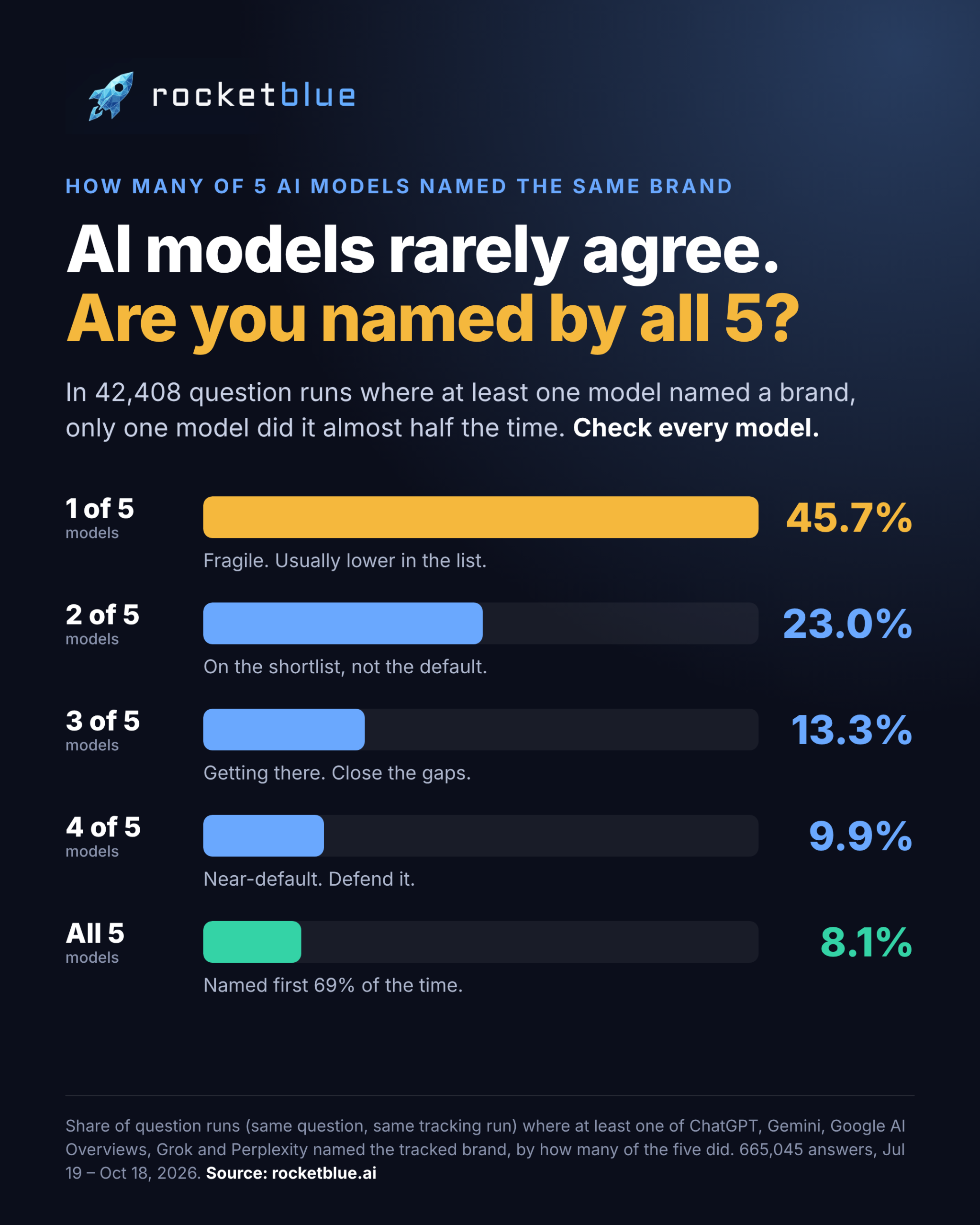
We grouped answers by “question run”: one tracked question, sent once to each of the five models, in the same tracking run. That gave us 133,009 question runs across 20,182 different questions. In 42,408 of them (31.9%), at least one model named the tracked brand.
Here is how many of the five models named the brand in those 42,408 question runs:
| Models that named the brand | Question runs | Share |
|---|---|---|
| Only 1 of 5 | 19,393 | 45.7% |
| 2 of 5 | 9,754 | 23.0% |
| 3 of 5 | 5,628 | 13.3% |
| 4 of 5 | 4,199 | 9.9% |
| All 5 | 3,434 | 8.1% |
Put another way, a majority of these mentions (54.3%) came with at least one other model agreeing, but only 31.3% had three or more models on board. If you check one AI tool, see your brand, and stop there, you are likely to overestimate how visible you are.
This matches what others have seen in smaller tests. A September 2026 analysis covered by TechRepublic found ChatGPT and Gemini often changed their top product pick when asked the same “best” question twice. Our data shows the same kind of gap between models, at much larger scale.
Grok Is the Most Common Lone Voice, but Removing It Changes Little
Grok names tracked brands more often than any other model in this set (16.9% of its answers). It also accounts for 25.1% of all brand mentions and 31.5% of the single-model mentions. So it is fair to ask whether Grok creates the disagreement.
It does not. Take Grok out and look at the other four models only. In the 36,297 question runs where at least one of those four named the brand, 50.8% had only one model naming it, and all four agreed just 10.7% of the time. The split between models is real, not a Grok quirk.
Each Model Agrees With the Others at a Different Rate
The table covers the same 133,009 question runs for every model, so the numbers are directly comparable. “Named alone” is the share of that model’s brand mentions where none of the other four named the brand in the same run.
| Model | Answers that named the brand | Named alone | All 5 agreed | Most likely to agree |
|---|---|---|---|---|
| Grok | 22,532 (16.9%) | 27.1% | 15.2% | Gemini, 47.8% |
| Gemini | 19,138 (14.4%) | 19.4% | 17.9% | Grok, 56.3% |
| ChatGPT | 17,772 (13.4%) | 19.4% | 19.3% | Grok, 59.1% |
| Google AI Overviews | 17,399 (13.1%) | 22.8% | 19.7% | Gemini, 53.1% |
| Perplexity | 12,910 (9.7%) | 16.6% | 26.6% | Grok, 61.9% |
“Most likely to agree” shows which other model most often named the brand in the same run, given that this model did. For example, when ChatGPT named a brand, Grok also named it 59.1% of the time, Gemini 54.1%, AI Overviews 46.3% and Perplexity 40.6%.
Perplexity stands out. It names tracked brands the least (9.7% of answers), but when it does, the others usually agree. On average, each of the other four models named the brand in the same run 55.8% of the time when Perplexity did. Grok is the opposite: it names brands the most, and the others agree with it the least (42.5% on average).
Brands Named by More Models Get Named First
Agreement is not just a count. It also tells you where you land in the answer. We looked at the brand’s position in each answer that named it:
| Models that named the brand | Answers | Named first | Named in the top 3 | Average position |
|---|---|---|---|---|
| Only 1 of 5 | 19,393 | 28.0% | 56.5% | 4.1 |
| 2 of 5 | 19,508 | 31.3% | 61.9% | 3.6 |
| 3 of 5 | 16,884 | 37.4% | 68.2% | 3.1 |
| 4 of 5 | 16,796 | 51.1% | 79.7% | 2.4 |
| All 5 | 17,170 | 69.1% | 89.4% | 1.8 |
When only one model names you, you are often further down a list. When all five name you, you are usually the first name the reader sees. Broad agreement and a top spot tend to go together. This is a pattern in the data, not proof that one causes the other, but it gives you a useful test: if only one tool mentions you, you are probably not the default answer yet.
Models Disagree Most at the Awareness Stage
Every tracked question is tagged with a buyer journey stage. Early questions (“what is the best way to…”) split the models the most. Questions closer to a purchase bring them together.
| Journey stage | Question runs with a mention | Only 1 model | 3 or more models | All 5 |
|---|---|---|---|---|
| Awareness | 9,731 | 48.8% | 27.7% | 5.7% |
| Consideration | 28,085 | 45.9% | 30.2% | 7.3% |
| Decision | 3,577 | 39.0% | 43.1% | 15.3% |
| Post-purchase | 842 | 34.1% | 56.8% | 33.3% |
The post-purchase group is small (842 question runs), so read it as a direction, not a precise number. The pattern is still clear. When buyers are just learning about a problem, each model builds its own shortlist. When the question is narrower, the models tend to land on the same brands. That makes awareness-stage visibility the hardest to win everywhere, and the most worth checking model by model. Visibility also shifts from week to week, so see our analysis of how often brands drop out of AI answers.
The picture is stable over time. The single-model share went from 48.2% (July 19 to August 18) to 45.3% (August 19 to September 18) to 44.3% (September 19 to October 18). Models are agreeing slightly more, but nearly half of mentions still come from just one of them.
Match Your Next Step to How Many Models Name You
| If you see… | What it likely means | Do this first | Don’t rely on |
|---|---|---|---|
| Named by 1 model | Fragile visibility, often low in the list (named first 28.0%) | Find which sources the other models cite for that question and get onto them | A single screenshot from one tool |
| Named by 2–3 models | You are on the shortlist but not the default | Make your category description the same everywhere so models describe you the same way | The model that already names you to carry the rest |
| Named by 4–5 models | You are close to the default answer (named first 51–69%) | Defend it: keep facts current and watch for drops each week | Last month’s result staying true |
| Named by Grok only | Grok is the most frequent lone voice (27.1% of its mentions) | Check Gemini and ChatGPT first; they agree with Grok most often | Grok as a stand-in for “AI search” |
| Named by Perplexity | A strong signal: others agree 55.8% of the time on average | Use the sources Perplexity cites as your outreach list for other models | Perplexity alone for volume; it names brands least often |
Checklist: Measure Your Cross-Model Visibility
The data backs the reason for this checklist: nearly half of mentions come from one model. The steps are our recommended way to measure it.
- Pick 20–30 questions buyers really ask. Mix stages: “best [category] for [audience]” (consideration), “how do I fix [problem]” (awareness) and “[your brand] vs [competitor]” (decision).
- Ask every question in at least five models. ChatGPT, Gemini, Google AI Overviews, Grok and Perplexity. Ask them on the same day so you compare like with like.
- Score each question 0 to 5. Count how many models named you. A question where you score 1 is a gap, not a win.
- Note your position too. Named first, in the top 3, or further down. Our data shows position improves as more models agree.
- Repeat every week. Answers change from run to run. One check is a snapshot, not a trend.
Checklist: Turn a One-Model Mention Into a Five-Model Mention
These steps are recommended practice. The data tells us agreement is rare and goes with better positions. It does not tell us which step causes it.
- Look at what the naming model cited. If Grok names you, open the sources in that answer. Those pages are working. Now check whether the same pages show up in the other models’ answers.
- Get onto the pages the other models cite. For a question where Gemini leaves you out, list the pages it cites. “Best X” lists and review sites are common. Ask to be added, or pitch an update. Our study of listicles and reviews shows which page types get brands named.
- Use one category sentence everywhere. “[Brand] is a [category] for [audience].” Put it on your homepage, About page, LinkedIn page and review profiles. Different models read different sources. The same sentence in each one helps them all reach the same answer.
- Make your own site easy to quote. Clear comparison pages and “who it’s for” pages help models that read your site directly. See when AI uses your own website.
- Start with awareness questions. That is where models disagree most (48.8% single-model mentions). Publish content that answers the problem question, not just the “best tool” question.
To see where AI models get their sources overall, check rocketblue’s AI visibility stats page, updated weekly.
How We Counted
- Window: answers saved from July 19 to October 18, 2026.
- Question run: one tracked question in one tracking run. We kept only the 133,009 question runs where all five models (ChatGPT, Gemini, Google AI Overviews, Grok and Perplexity) answered. That is 665,045 answers, covering 20,182 questions and 1,967 tracking runs.
- Named: the answer mentioned the brand being tracked for that question. If a model answered the same question more than once in a run, it counts as named if any of those answers named the brand.
- Position: the brand’s place among all brands named in that answer, where 1 means named first.
- Left out: Google AI Mode and Claude, because they were tracked in fewer runs, and Copilot, because its sample was too small. Including them would mix question runs with different numbers of models.
- Privacy: results are pooled across many brands and categories. We do not show any single brand’s data.
FAQ
Do ChatGPT, Gemini and Perplexity recommend the same brands?
Often not. In 42,408 question runs where at least one of five models named a tracked brand, only one model did so 45.7% of the time. All five named it just 8.1% of the time.
If ChatGPT mentions my brand, will other AI tools mention it too?
About half the time. When ChatGPT named a brand, Grok also named it in the same run 59.1% of the time, Gemini 54.1%, Google AI Overviews 46.3% and Perplexity 40.6%.
Which AI model mentions brands the most?
Grok, in this data. It named the tracked brand in 16.9% of its answers, compared with 9.7% for Perplexity. But Grok was also the most likely to be the only model naming the brand.
Why do different AI models give different brand recommendations?
Each model uses different training data, different search tools and different sources when it builds an answer. Early-stage questions leave the most room for that, which is why awareness questions show the most disagreement.
How should I track my brand’s visibility across AI models?
Ask the same buyer questions in at least five models on the same day, score each question by how many models named you (0 to 5), note your position, and repeat weekly. A tool like rocketblue automates this.
What should I change if only one AI model mentions my brand?
Look at which sources the other models cite for that question and work on getting onto them, such as “best X” lists and review sites. Use the same one-line category description on your site and every profile. Start with awareness-stage questions, where models disagree most.

Michael Hermon
Before rocketblue, Michael led Innovation and AI at monday.com after exiting his previous startup. He learned to code at 13 at MIT and later attended Columbia’s MBA program.
https://linkedin.com/in/michaelhermon